
Starship SN10 Sticks The Landing... and Then Experiences A 'RUD' | Aero-News Network
Aero-News Network
RSS icon RSS feed
podcast icon MP3 podcast
Subscribe Aero-News e-mail Newsletter Subscribe

Airborne Unlimited -- Most Recent Daily Episodes

Episode Date

Airborne-Monday

Airborne-Tuesday

Airborne-Wednesday Airborne-Thursday

Airborne-Friday

Airborne On YouTube

Airborne-SpecialEpisode-12.15.25

AirborneNextGen-
12.16.25

Airborne-Unlimited-12.10.25

Airborne-AffordableFlyers-12.11.25

AirborneUnlimited-12.12.25

AFE 2025 LIVE MOSAIC Town Hall (Archived): www.airborne-live.net

Fri, Mar 05, 2021

Starship SN10 Sticks The Landing... and Then Experiences A 'RUD'

Reported Hard Landing May Have Created Explosive Results Several Minutes After Touchdown

SpaceX-watching is one of the most exciting pursuits in the aerospace world. Between their extraordinary successes, and their occasional explosive disappointments, watching their efforts is rarely disappointing. 

On Wednesday, March 3, Starship serial number (SN10) successfully completed SpaceX’s third high-altitude flight test of a Starship prototype from a SpaceX test site in Cameron County, Texas.

Similar to the high-altitude flight tests of Starship SN8 and SN9, SN10 was powered through ascent by three Raptor engines, each shutting down in sequence prior to the vehicle reaching apogee – approximately 10 km in altitude. SN10 performed a propellant transition to the internal header tanks, which hold landing propellant, before reorienting itself for reentry and a controlled aerodynamic descent.

The Starship prototype descended under active aerodynamic control, accomplished by independent movement of two forward and two aft flaps on the vehicle. All four flaps were actuated by an onboard flight computer to control Starship’s attitude during flight and enabled a precise landing at the intended location. SN10’s Raptor engines reignited as the vehicle performed the landing flip maneuver immediately before successfully touching down on the landing pad... though it did seem to have a bit of an off-vertical tilt when it all came to rest and the landing legs appear to have collapsed.

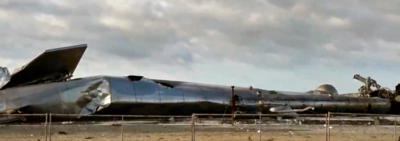
As if the flight test was not exciting enough, SN10 experienced a rapid unscheduled disassembly shortly after landing. All in all, it was almost a great day for the Starship teams – though, these test flights are all about improving the company's understanding and development of a fully reusable transportation system designed to carry both crew and cargo on long-duration interplanetary flights, and help humanity return to the Moon, and travel to Mars and beyond.

FMI: www.spacex.com


Advertisement

More News

ANN's Daily Aero-Term (12.19.25): Ultrahigh Frequency (UHF)

Ultrahigh Frequency (UHF) The frequency band between 300 and 3,000 MHz. The bank of radio frequencies used for military air/ground voice communications. In some instances this may >[...]

NTSB Prelim: Cirrus Design Corp SR22T

During The 7 Second Descent, There Was Another TAWS Alert At Which Time The Engine Remained At Full Power On October 24, 2025 at 2115 mountain daylight time, a Cirrus SR22T, N740TS>[...]

Classic Aero-TV: The Red Tail Project--Carrying the Torch of the Tuskegee Airmen

From 2009 (YouTube Edition): Educational Organization Aims to Inspire by Sharing Tuskegee Story Founding leader Don Hinz summarized the Red Tail Project’s mission in simple, >[...]

Aero-News: Quote of the Day (12.19.25)

“This feels like an important step since space travel for people with disabilities is still in its very early days... I’m so thankful and hope it inspires a change in m>[...]

Airborne 12.17.25: Skydiver Hooks Tail, Cooper Rotax Mount, NTSB v NDAA

Also: New Katanas, Kern County FD Training, IndiGo’s Botched Roster, MGen. Leavitt Named ERAU Dean The Australian Transportation Safety Bureau (ATSB) has wrapped up its inves>[...]

blog comments powered by Disqus



Advertisement

Advertisement

Podcasts

Advertisement

© 2007 - 2025 Web Development & Design by Pauli Systems, LC

