

UAS Gives Scientists 3D View Of Atmosphere | Aero-News Network
Aero-News Network
RSS icon RSS feed
podcast icon MP3 podcast
Subscribe Aero-News e-mail Newsletter Subscribe

Airborne Unlimited -- Most Recent Daily Episodes

Episode Date

Airborne-Monday

Airborne-Tuesday

Airborne-Wednesday Airborne-Thursday

Airborne-Friday

Airborne On YouTube

Airborne-Unlimited-12.01.25

AirborneNextGen-
12.02.25

Airborne-Unlimited-12.03.25

Airborne-AffordableFlyers-11.20.25

AirborneUnlimited-11.21.25

LIVE MOSAIC Town Hall (Archived): www.airborne-live.net

Mon, Jan 11, 2010

UAS Gives Scientists 3D View Of Atmosphere

Trio Of Aircraft Used In Climate Research

Scientists at Scripps Institution of Oceanography at UC San Diego have been using a fleet of Manta autonomous UAVs to track pollution and atmospheric data over the skies of Southern California.  The California AUAV Air Pollution Profiling Study (CAPPS) program is the latest in a series of science missions using UAS around the world.

The CAPPS began data collection on April 2, gathering a suite of meteorological data as they fly through clouds and aerosol masses in Southern California skies. When flying in formation, the aircraft can provide researchers with a unique three-dimensional view of atmospheric composition.

Miniaturized instruments on the aircraft, which typically flew in formations of three, measured a range of properties such as the quantity and size of the aerosols on which cloud droplets form. The instruments also recorded variables such as temperature, humidity and the intensity of light that permeates clouds and masses of smog. These comprehensive measurements were made at a very low cost when compared to traditional manned flights.


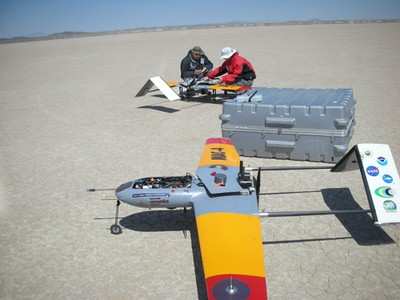
Technicians prepare the Manta for launch at Edwards AFB.

The Manta is one of several UAS produced by Advanced Ceramics Research in Tucson, AZ, now a part of BAE Systems.  Manta can carry a 15-lb payload for up to 6 hrs with a typical service altitude of 2,000-12,000 ft.  The aircraft have been deploying from NASA's Dryden Flight Research Center at Edwards AFB

Scripps researches hope to fly the system at least once a month to monitor Southern CA skies.  Future applications include real-time situational awareness during forest fires.

FMI: www.ARCTucson.com, sio.ucsd.edu

Advertisement

More News

ANN's Daily Aero-Term (12.01.25): Convective SIGMET

Convective SIGMET A weather advisory concerning convective weather significant to the safety of all aircraft. Convective SIGMETs are issued for tornadoes, lines of thunderstorms, e>[...]

ANN's Daily Aero-Linx (12.01.25)

Aero Linx: United Flying Octogenarians WELCOME to a most extraordinary group of aviators, the United Flying Octogenarians (UFO). Founded in 1982 with just a handful of pilots, we h>[...]

NTSB Final Report: Remos Aircraft GmbH Remos GX

Pilot’s Decision To Attempt Takeoff With Frost Covering The Airplane’s Wings Analysis: The pilot of the light sport airplane was preparing to depart for a cross-country>[...]

Aero-News: Quote of the Day (12.02.25)

“We’ve paid for the cable line’s repair for the customer and have apologized for the inconvenience this caused them...” Source: Some followup info from an A>[...]

ANN's Daily Aero-Term (12.02.25): Coupled Approach

Coupled Approach An instrument approach performed by the aircraft autopilot, and/or visually depicted on the flight director, which is receiving position information and/or steerin>[...]

blog comments powered by Disqus



Advertisement

Advertisement

Podcasts

Advertisement

© 2007 - 2025 Web Development & Design by Pauli Systems, LC

