Draper Laboratory Says Precision Airdrops Are Beating US
Military Design Specs
The US military conducted the first operational mission in
Afghanistan in May with a system that allows it to drop supplies
such as food, water and ammunition from cargo planes far more
accurately than in the past. The technique has the potential to
reduce troop casualties and give the military another option for
assisting with some humanitarian operations. Draper Laboratory says
software it developed is responsible for the dramatic increase in
accuracy for the 2,000 pound payload system.
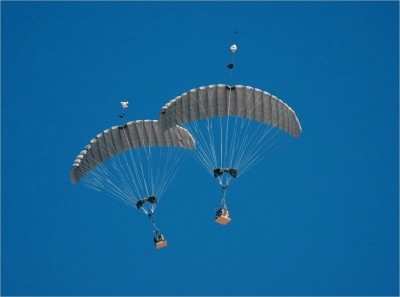
JPADS, the US Army’s Joint Precision Airdrop 2K system,
operates completely autonomously once dropped from a C-17 or C-130
cargo plane. It could lead the military to revamp its tactics for
resupply by reducing the need for truck convoys that leave troops
vulnerable to enemy fire. It could also lessen the urgency for some
cargo UAVs currently on the drawing board, essentially light "air
trucks" which would carry much smaller loads than a Hercules or
Globemaster.
Currently, Draper notes US and allied troops in Afghanistan
receive roughly 75 percent of their supplies from trucks
maneuvering along the Khyber Pass, where Taliban and Al-Qaeda
attacks on ground vehicles and helicopters have resulted in high
rates of casualties. The military also deals with harsh weather
conditions in the winter months, and mountainous terrain.
Those concerns led the US Army to begin a rapid development
program in February 2010 for an improved precision airdrop
capability that could avoid difficult ground terrain in order to
accurately reach those troops. Draper responded by turning the
capability around in less than a year for under $1.5 million. By
landing supplies far closer to U.S. forces on the battlefield than
was previously possible, the improved accuracy also vastly reduces
the time that troops on the battlefield need to be exposed to
potential enemy fire while recovering supplies. Draper demonstrated
that the system could exceed the military’s accuracy and
obstacle avoidance goals while operating in terrain similar to that
of Afghanistan during testing at Yuma Proving Ground during the
past year.
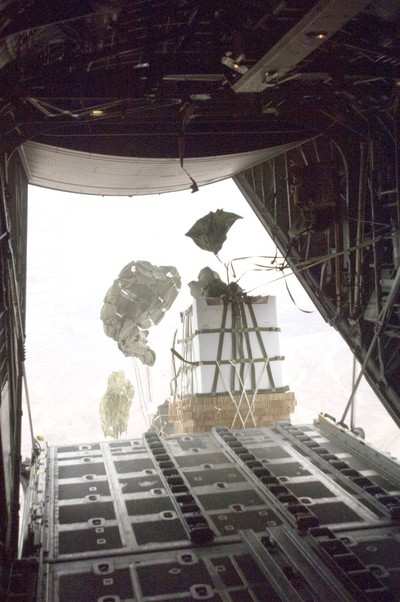
The Army recently deployed an initial increment of JPADS 2K
systems utilizing the Draper software to Afghanistan for use in
Operational Enduring Freedom, and is currently developing plans to
convert future deployed systems to Draper’s software. Results
for all systems exceeded the Army’s goals during the first
operational mission in May.
The Draper-developed JPADS guidance, navigation and control
software is non-proprietary, owned by the government, and
applicable to a wide variety of hardware platforms, so it could be
used in other missions such as relief efforts. One potential
example of humanitarian resupply in which high accuracy is required
is if the US government is delivering supplies to civilians and
needs to ensure that the provisions do not fall into enemy
hands.
Draper has successfully flown the software on platforms
manufactured by several vendors with payload capacity ranging from
five pounds, which could handle medical supplies, blood packets, or
sensors, to 42,000 pounds, which could handle a truck or armored
vehicle.



 ANN's Daily Aero-Linx (12.12.25)


 See All