Mattituck's Phil Haponic Explains
 Bruce Bohannon's Exxon Flyin' Tiger may
have one record that could stand longer than even its time-to-climb
and altitude records: it set seven world records on a
single flight. While we knew of several of these, and reported on
the flight, it was quite some time before even Bruce or his
sponsors knew just how dominant his flight was. For your
edification (and to let Bruce know that we pay attention), here are
all seven records, set during a single flight, on October 22 of
last year.
Bruce Bohannon's Exxon Flyin' Tiger may
have one record that could stand longer than even its time-to-climb
and altitude records: it set seven world records on a
single flight. While we knew of several of these, and reported on
the flight, it was quite some time before even Bruce or his
sponsors knew just how dominant his flight was. For your
edification (and to let Bruce know that we pay attention), here are
all seven records, set during a single flight, on October 22 of
last year.
In Class C-1 (Unlimited -- piston-powered aircraft of
any weight)
|
|
| Time to Climb to 12,000 Meters: |
31:03 |
| Time to Climb to 9000 Meters: |
16:03 |
| Altitude Achieved in Horizontal Flight: |
40,604 Feet* |
| In Class C-1.b (Piston-powered aircraft between 1102
and 2205 pounds) |
|
| Absolute Altitude: |
41,611 feet |
| Time to Climb to 12,000 Meters: |
31:03 |
| Time to Climb to 9000 Meters: |
16:03 |
| Altitude in Horizontal Flight: |
40,604 feet |
|
|
|
* The old record, 35,497 feet, was also held by the Exxon
Flyin' Tiger, in class C-1.b
Of course, it takes a whole lot more than an engine to make
these records happen, and we've covered a number of the required
factors -- crew, pilot, engineering, weather -- but nobody's going
to argue with the fact that it takes a darned good engine turning a
darned good prop.
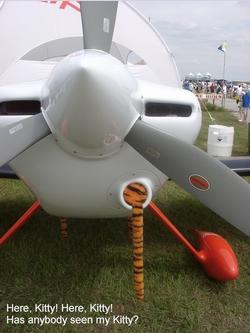 The Flyin' Tiger's engines are built by
Teledyne Mattituck Services, and we cornered Mattituck's Chief
Inspector, Phil Haponic, at Sun 'n Fun, to tell us
about what it took to make such a mill.
The Flyin' Tiger's engines are built by
Teledyne Mattituck Services, and we cornered Mattituck's Chief
Inspector, Phil Haponic, at Sun 'n Fun, to tell us
about what it took to make such a mill.
Haponic has been with Mattituck 28 years, and has seen a lot of
champions. (He built Leo Laudenslager's engines for 15 years.)
Power, though, is secondary. Phil told us, "Safety is the big
thing. If you dig into one of these [engines] too quickly, it'll
fall apart."
The first "build" isn't made of metal; it's on a computer. "It's
very close, in terms of most performance characteristics, to the
finished engine," he explained. After the computer "build," though,
Phil says the fun starts: "Then you have to be able to build the
parts -- even to get the parts."
Here's a bit of what goes into Bruce's 555 inch, 355hp
engine:
- The crankshaft is reground to lengthen the stroke .100", hence
the displacement of 555 cubes. Phil says about six such cranks have
existed, through time.
- The cylinders are stock-bore Superior parts, though the
piston-to-wall clearance is increased, Phil says, "a little."
-
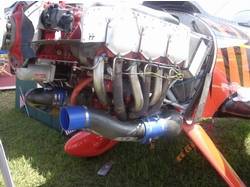 The heads incorporate some special valves: the
intakes are special-made, and the sodium-filled exhausts are
oversize units, from a slant-valve engine. "They almost touch, as
they go up and down," says the master builder.
The heads incorporate some special valves: the
intakes are special-made, and the sodium-filled exhausts are
oversize units, from a slant-valve engine. "They almost touch, as
they go up and down," says the master builder.
- Connecting rods are selected to be a close match; then they're
precisely matched. "Standard hot-rod stuff," Haponic notes.
- The pistons, which push nearly a 13:1 compression ratio, are
slant-valve pistons, with custome-made tops. Special lightweight
wristpins are used.
- After all the selection, and at several points in the building,
everything gets dynamically balanced.
The turbocharger (not a Mattituck part, and featured in our
earlier Bohannon coverage) provides sea-level performance to "26 or
27 thousand feet," according to Bruce.
As for other hot-rod conventions, Phil says, "There's not too
much polishing of components -- mostly just what's needed for
aesthetics." In other words, the polishing is on the
outside of the engine, so people can go "ooh" and "ah,"
not on the inside...
If there were a breakthrough...
 Phil (right) says that development of the current
recipe took a little over two years, maybe two and a half, of
often-intensive 'part-time' work. The computer helped; but the data
the computers generate still need to be translated into metal.
Phil (right) says that development of the current
recipe took a little over two years, maybe two and a half, of
often-intensive 'part-time' work. The computer helped; but the data
the computers generate still need to be translated into metal.
The "breakthrough," if a single point could be tagged, was in
the cam profile. A lot of attention to the standard parameters --
lift, timing, duration -- led to some tricky problems in profile,
on both opening and closing.
Added to that was the consideration of the unique piston crowns
and the special valves -- the geometry was more than a trivial
exercise.
Horsepower isn't the whole story.
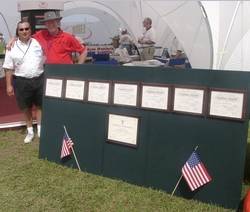 Bohannon told us, "We run 24-24 most of the time.
That's probably 230 horsepower or so."
Bohannon told us, "We run 24-24 most of the time.
That's probably 230 horsepower or so."
"Was that enough?" we asked rhetorically, remembering that all
those framed records didn't come from a mail-order catalog.
"Yeah -- that, plus a high airspeed," he replied. [The Exxon
Flyin' Tiger is one fast machine. Leveled off at 40,000 feet
(!), it was quickly indicating 165 knots -- over 320 mph on the
ground! --ed.]
What about all the computer design stuff?
With the computer's ability to get close to reality, so quickly,
why did it take over two years?
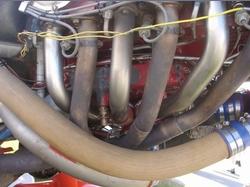 Phil rolled his eyes, but remained polite. "The
computer design is close to what you want," he admitted, "but it
all takes time... and money. Step, step, step... piece, piece,
piece." Mr. Haponic used two dynamometers in the development. One
was a more-or-less standard water-brake dyno, like a hot-rod shop
would recognize; the other was a prop dyno, where the engine is
loaded, not by a water brake, but by actual air, just like in an
airplane. Once the initial build is ready, he says, "You
experiment. We used two different fuel injection systems, two
different servos for the lambda (sensor)..."
Phil rolled his eyes, but remained polite. "The
computer design is close to what you want," he admitted, "but it
all takes time... and money. Step, step, step... piece, piece,
piece." Mr. Haponic used two dynamometers in the development. One
was a more-or-less standard water-brake dyno, like a hot-rod shop
would recognize; the other was a prop dyno, where the engine is
loaded, not by a water brake, but by actual air, just like in an
airplane. Once the initial build is ready, he says, "You
experiment. We used two different fuel injection systems, two
different servos for the lambda (sensor)..."
The prop dyno was doubly revealing, especially as the flying
days got closer. Variable-speed cooling was used during dyno runs,
to learn and plot heating/cooling effects, to understand fuel burn
and internal temps, and to get as close to actual flight conditions
as possible.
Not off-the-shelf
Virtually everything in, on, and around the engine has been
specially-selected, specially-worked, and specially-built. The
result is not only a safe and reliable engine, it is an engine that
has the ability to go out and set records (if properly installed,
tuned, maintained, and flown).
There is one other engine like this, and it's packing
fifteen or twenty more horsepower, even. Its design isn't
identical, though, as its mission profile is very different: it's
in a Zivko Edge 540, and its aerobatic future will get surely get
coverage in ANN.
 As for how you can get an engine like this, and
how much it will cost, Phil says that's not a good question for you
to be asking. Have your sponsor(s) call Mattituck. What -- you
don't have sponsors? Then you don't want to know.
As for how you can get an engine like this, and
how much it will cost, Phil says that's not a good question for you
to be asking. Have your sponsor(s) call Mattituck. What -- you
don't have sponsors? Then you don't want to know.
As for Phil Haponic, he says he has dreams, just like everybody
else: "What I really want to do is build a 602 [cubic inch engine].
I need a crank..."



 Airbus Racer Helicopter Demonstrator First Flight Part of Clean Sky 2 Initiative

 See All