 ANN REALTIME REPORTING
08.02.06 1800 EDT: The National Transportation Safety Board has
just released its Preliminary Report on last week's fatal accident
involving the prototype Spectrum 33 very-light-jet in Utah.
ANN REALTIME REPORTING
08.02.06 1800 EDT: The National Transportation Safety Board has
just released its Preliminary Report on last week's fatal accident
involving the prototype Spectrum 33 very-light-jet in Utah.
In its report -- which is published in its entirety below -- the
NTSB says the aircraft's ailerons were apparently misrigged... so
that control inputs for roll control would have had the opposite
effect than the plane's pilots intended.
"Examination of the translation linkage on the aft side of the
aft pressure bulkhead revealed that it was connected in a manner
that reversed the roll control," say the Prelim. "Specifically, the
linkage was connected such that left roll input from the side
sticks would have deflected the ailerons to produce right roll of
the airplane, and right roll input from the side sticks would have
deflected the ailerons to produce left roll of the airplane."
The NTSB also reports the airplane had undergone maintenance
prior to the accident, during which time the main landing gear was
removed in order to stiffen the struts. When workers reinstalled
the MLG, the NTSB says they found the modifications resulted in
inadequate clearance between the left MLG strut, and the aileron
upper torque tube V-bracket. The V-bracket was removed and
redesigned to allow proper clearance of the gear... which also
required a portion of the aileron linkage to be removed, and
subsequently reinstalled.

Witnesses report the aircraft entered a right roll just as the
plane was lifting off from runway 30 at Spanish Fork-Springville
Airport in Spanish Fork, UT in July 25. As Aero-News reported,
Spectrum's Glenn Maben and Nathan Forrest were lost in the
accident.
NTSB PRELIMINARY REPORT
On July 25, 2006, approximately 1606 mountain daylight time, a
Spectrum 33 experimental twin-engine jet airplane, N322LA, collided
with terrain following a loss of control during the initial climb
after takeoff from runway 30 at Spanish Fork-Springville Airport,
Spanish Fork, Utah. The airplane, which was registered to and
operated by Spectrum Aeronautical LLC, was destroyed by impact
forces. The two commercial pilots aboard received fatal injuries.
Visual meteorological conditions prevailed and no flight plan was
filed for the 14 CFR Part 91 local maintenance test flight. The
flight was originating when the accident occurred.

Witness observations indicate that the airplane entered a right
roll almost immediately after takeoff. The roll continued to about
90 degrees right wing down when the right wingtip impacted the
ground.
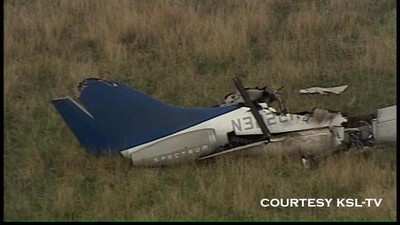
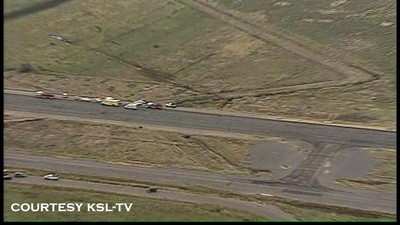
Examination of the accident site revealed that the initial
impact point was located about 150 feet right of the runway 30
centerline. A ground scar oriented on a magnetic heading of about
330 degrees extended from the initial impact point to a barbed wire
fence about 120 feet away. Various pieces of right wing debris were
found along the ground scar. The wreckage path veered about 20
degrees right at the fence and then remained essentially straight
to the main wreckage site on about a 350 degree magnetic heading.
The main wreckage was located about 750 feet from the initial
impact point and included the forward fuselage, aft fuselage and a
majority of the wing structure. All major components of the
airplane were accounted for in the wreckage path or with the main
wreckage. There was no evidence found of any pre-existing failures
of the airplane's structure.
Roll control on the airplane was from the pilots' side sticks to
the ailerons through a mechanical system of torque tubes and
push-pull tubes. The left side stick was primary, and the right
side stick was slaved to the left side stick. The roll control
motion of the left side stick was linked through a quadrant below
the cockpit floor to the lower torque tube. The lower torque tube
ran from the quadrant to the aft pressure bulkhead. The translation
linkage, the linkages and bell cranks that translated the
rotational motion of the lower torque tube to a linear motion of
the aileron push-pull tubes, was located on the aft side of the
pressure bulkhead in the main landing gear (MLG) gearbox area.
During examination of the wreckage, aileron control continuity
could not be established from the cockpit to the aft pressure
bulkhead due to fragmentation of the airplane, however, all of the
lower torque tube was accounted for. Control continuity was
established from the torque tube input on the aft pressure bulkhead
to the aileron bellcrank on the right wing and to the torque tube
about 50 inches inboard of the aileron bellcrank on the left wing.
Examination of the translation linkage on the aft side of the aft
pressure bulkhead revealed that it was connected in a manner that
reversed the roll control. Specifically, the linkage was connected
such that left roll input from the side sticks would have deflected
the ailerons to produce right roll of the airplane, and right roll
input from the side sticks would have deflected the ailerons to
produce left roll of the airplane.
According to information provided by the operator, the airplane
had accumulated about 44 hours total flight time since its first
flight on January 7, 2006. Prior to the accident flight, the
airplane's most recent flight, flight number 46, had taken place on
June 30, 2006. During the time between flight 46 and the accident
flight, the airplane had been undergoing maintenance. The
maintenance included removal of the MLG in order to stiffen the MLG
struts. Upon reinstallation of the MLG, it was found that
inadequate clearance now existed between the left MLG strut and the
aileron upper torque tube V-bracket. The V-bracket was removed and
redesigned to allow proper clearance of the MLG. Removal of the
V-bracket required disconnection and removal of a portion of the
translation linkage.



 Aero-News: Quote of the Day (10.23.25)


 See All