Voyager 1 Approaches Interstellar Space | Aero-News Network
Aero-News Network
RSS icon RSS feed
podcast icon MP3 podcast
Subscribe Aero-News e-mail Newsletter Subscribe

** AIRBORNE 05.17.13 Aero-TV-- CLICK HERE! ** HD iPad-Friendly Version -- AIRBORNE 05.17.13 **

** AIRBORNE 05.14.13 Aero-TV-- CLICK HERE! ** HD iPad-Friendly Version -- AIRBORNE 05.14.13 **

** AIRBORNE 04.01.13 SPECIAL EDITION of Aero-TV-- CLICK HERE! ** HD iPad-Friendly Version -- AIRBORNE 04.01.13 SPECIAL EDITION **

Sun, Dec 26, 2010

Voyager 1 Approaches Interstellar Space

Commands Take 16 Hours To Reach The Spacecraft

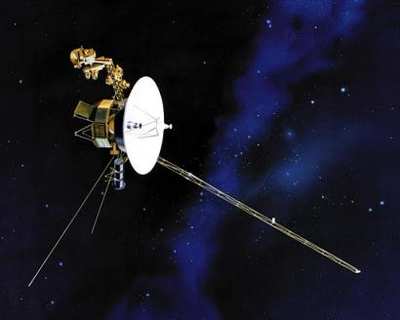
NASA recently said that Voyager 1 has reached a point at the edge of our solar system where there is no outward motion of solar wind. Now approximately 10.8 billion miles from the sun, Voyager 1's passage through the heliosheath, the turbulent outer shell of the sun's sphere of influence, and the spacecraft's upcoming departure from our solar system, mark a major milestone as it will become mankind's first interstellar probe. In about 40,000 years, Voyager 1 will drift within 1.6 light years (9.3 trillion miles) of AC+79 3888, a star in the constellation of Camelopardalis. Signals to command the thrusters now take more than 16 hours to reach the spacecraft.


Voyager 1 Artist's Rendering

Voyager 1 and Voyager 2 were launched in 1977, and are the oldest operational spacecraft. At launch, each spacecraft carried two propulsion systems, a Delta-V system, including four 100 lbf and four 5 lbf monopropellant hydrazine thrusters made by Aerojet, and an attitude control system including 16 0.2 lbf monopropellant hydrazine thrusters. The Delta-V systems have long since been jettisoned, but the attitude control systems remain operational today. The 100 lbf thrusters are the original version of the thrusters intended for Orion's crew module and the 0.2 lbf thrusters are the original version of the thrusters currently in use for the Global Positioning System Block IIR, and are similar to those newly in service for GPS Block IIF.

"Voyager has transformed our understanding of the solar system," said Aerojet Program Manager Jon Schierberl. "Aerojet is proud to have been a part of the mission every step of the way." Schierberl is one of a handful of people at Aerojet who has worked programs (including Voyager) that have explored or will explore every planet in the solar system.

FMI: www.Aerojet.com

Advertisement

More News

Aero-News: Quote Of The Day (05.19.13)

"There are a million reasons to pick the C-130J, as the Hercules continues to demonstrate the ability to fulfill any mission at any time. Not only is this milestone a testament to >[...]

ANN FAQ: Have You Tried The ANN News Ticker?

Several years ago, ANN's first web-geek, Al Pike, designed a small "portable" News Ticker that offers current ANN headlines detailing what is happening in the aviation world. It ca>[...]

ANN's Daily Aero-Linx (05.19.13)

Aero Linx: Aerospace Medical Association (AsMA) The Aerospace Medical Association (AsMA) is organized exclusively for charitable, educational, and scientific purposes. It is the la>[...]

ANN's Daily Aero-Term (05.19.13): Direct

Direct Straight line flight between two navigational aids, fixes, points, or any combination thereof. When used by pilots in describing off-airway routes, points defining direct ro>[...]

Raytheon Delivers Electronic Jamming Capability For Gray Eagle UAS

Effort Will Mark First Time Army Has ECM Capability On Unmanned Aircraft Two electronic attack payloads in support of the U.S. Army's Networked Electronic Warfare, Remotely Operate>[...]

blog comments powered by Disqus


Advertisement

Advertisement

Podcasts

Advertisement

© 2007 - 2013 Web Development & Design by Pauli Systems, LC