
Osprey Completes Final Shipboard Developmental Testing | Aero-News Network
Aero-News Network
RSS icon RSS feed
podcast icon MP3 podcast
Subscribe Aero-News e-mail Newsletter Subscribe

Airborne Unlimited -- Most Recent Daily Episodes

Episode Date

Airborne-Monday

Airborne-Tuesday

Airborne-Wednesday Airborne-Thursday

Airborne-Friday

Airborne On YouTube

Airborne-Unlimited-12.08.25

AirborneNextGen-
12.02.25

Airborne-Unlimited-12.03.25

Airborne-FltTraining-12.04.25

AirborneUnlimited-12.05.25

AFE 2025 LIVE MOSAIC Town Hall (Archived): www.airborne-live.net

Tue, Dec 07, 2004

Osprey Completes Final Shipboard Developmental Testing

Important Step Toward Op Eval Next Year

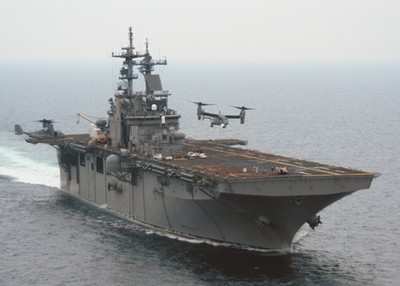
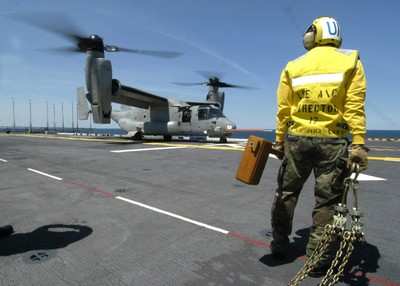
The V-22 Integrated Test Team conducted Shipboard Suitability Phase IVc for ten days beginning on November 12. This was the fourth and final underway period for the ITT since the program’s return to flight in May of 2002. Phase IVc’s successful completion was an important step on the path toward the Osprey’s operational evaluation early next year.

The primary objective of this phase was to complete interaction testing between a V-22 parked on the flight deck and another V-22 hovering in front of it. Additional test objectives included flight envelope expansion for all port side landing spots aboard the LHD, developing a night short takeoff envelope, and evaluating the latest flight control software version.

“The team was able to get a lot done during our time underway,” said Bill Geyer, the ITT’s lead shipboard suitability engineer. “The data we gathered will help us close the book on MV-22 shipboard developmental test. We’ve given the operational testers and, in turn, the fleet the tools for success at sea.”

While the ITT was busy working on the Wasp’s flight deck, a group of maintainers from VMX-22, the V-22 operational test and evaluation squadron based at MCAS New River, were in the hangar bay conducting maintenance demonstration testing. Tests included removing both engines, jacking the aircraft and cycling the landing gear, and removing prop-rotor hubs and blade assemblies. The VMX-22 team’s findings will serve them well during the squadron’s upcoming operational evaluation.

Geyer was quick to attribute the ITT’s success to their hosts. “The Wasp was excellent,” he said. “The bridge team went out of its way to get us the winds we needed, and the Air Department was always willing to go the extra mile to get the job done for us. Overall, it was the best experience I’ve ever had at sea while conducting tests.”

(ANN salutes Ward Carroll, NAVAIR Public Affairs)

FMI: www.navair.navy.mil

Advertisement

More News

NTSB Final Report: Patriot Aircraft LLC CX1900A

After Draining Both Wing Fuel Tanks, A Significant Amount Of Water Was Observed In The Right Wing Fuel Tank Analysis: The pilot, who was also the owner of the experimental amateur->[...]

Aero-News: Quote of the Day (12.06.25)

“Airbus apologises for any challenges and delays caused to passengers and airlines by this event. The Company thanks its customers, the authorities, its employees and all rel>[...]

ANN's Daily Aero-Term (12.06.25): High Speed Taxiway

High Speed Taxiway A long radius taxiway designed and provided with lighting or marking to define the path of aircraft, traveling at high speed (up to 60 knots), from the runway ce>[...]

ANN's Daily Aero-Linx (12.06.25)

Aero Linx: Taylorcraft Foundation, Inc. The Taylorcraft Foundation is exclusively organized for charitable, educational & scientific activities and will preserve the history an>[...]

Airborne-NextGen 12.02.25: Honda eVTOL, Arctus High-Alt UAS, Samson Patent

Also: USAF Reaper Accident, Baikonur Damage, Horizon eVTOL IFR/FIKI, New Glenn Update Honda has outlined its clearest timeline yet for its entry into the world of electric vertical>[...]

blog comments powered by Disqus



Advertisement

Advertisement

Podcasts

Advertisement

© 2007 - 2025 Web Development & Design by Pauli Systems, LC

