

NASA Tests Alternate Launch Abort System For Astronaut Escape | Aero-News Network
Aero-News Network
RSS icon RSS feed
podcast icon MP3 podcast
Subscribe Aero-News e-mail Newsletter Subscribe

Airborne Unlimited -- Most Recent Daily Episodes

Episode Date

Airborne-Monday

Airborne-Tuesday

Airborne-Wednesday Airborne-Thursday

Airborne-Friday

Airborne On YouTube

Airborne-Unlimited-12.08.25

AirborneNextGen-
12.02.25

Airborne-Unlimited-12.03.25

Airborne-FltTraining-12.04.25

AirborneUnlimited-12.05.25

AFE 2025 LIVE MOSAIC Town Hall (Archived): www.airborne-live.net

Thu, Jul 09, 2009

NASA Tests Alternate Launch Abort System For Astronaut Escape

Launch Emergency Simulation Was Successful

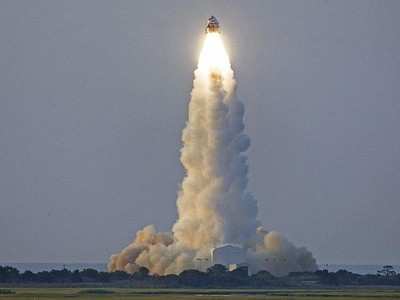
NASA has successfully demonstrated an alternate system for future astronauts to escape their launch vehicle. A simulated launch of the Max Launch Abort System, or MLAS, took place Wednesday at 0626 at NASA's Wallops Flight Facility, Wallops Island, VA.

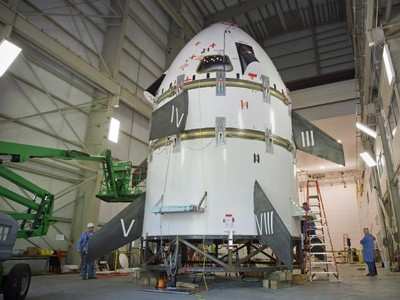
The unpiloted launch tested an alternate concept for safely propelling a future spacecraft and its crew away from a problem on the launch pad or during ascent. The MLAS consists of four solid rocket abort motors inside a bullet-shaped composite fairing attached to a full-scale mockup of the crew module.

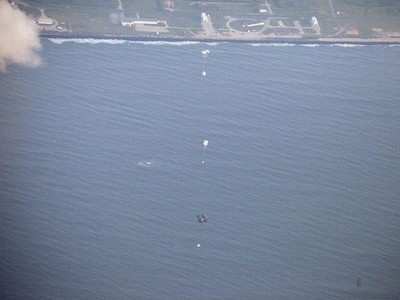
The 33-foot-high MLAS vehicle was launched to an altitude of approximately one mile to simulate an emergency on the launch pad. The flight demonstration began after the four solid rocket motors burned out. The crew module mockup separated from the launch vehicle at approximately seven seconds into the flight and parachuted into the Atlantic Ocean.

The test demonstrated a number of things: the unpowered flight of the MLAS along a stable trajectory; reorientation and stabilization of the MLAS; separation of the crew module simulator from the abort motors; and stabilization and parachute recovery of the crew module simulator. An important objective of the test was to provide the workforce of NASA's Engineering and Safety Center, or NESC, with experience in flight testing a spacecraft concept. NESC leads the project at NASA's Langley Research Center in Hampton, Va.

NASA has chosen another launch abort system, known as the LAS, for the Orion spacecraft. The system has a single solid launch abort motor in a tower mounted at the top of the launch vehicle stack of the Orion and Ares I rocket. The LAS will be capable of automatically separating the spacecraft from the rocket at a moment's notice to make possible a safe landing. Orion, part of a new spacecraft system NASA's Constellation Program is developing, is undergoing design reviews in preparation for flying astronauts to the International Space Station in 2015 and, later, to the moon.

Data from today's MLAS pad abort test could help NASA in several ways. MLAS is the first demonstration of a passively-stabilized launch abort system on a vehicle in this size and weight class. It is the first attempt to acquire full-scale aero-acoustic data -- the measurement of high loads on a vehicle moving through the atmosphere at high velocity -- from a faired capsule in flight. The test is also the first to demonstrate full scale fairing and crew module separation and collect associated aerodynamic and orientation data. In addition, data from the parachute element will help validate simulation tools and techniques for Orion's parachute system development.

The NESC is an independently funded NASA program that draws on technical experts from across all NASA centers to provide objective engineering and safety assessments of critical, high risk projects.

The MLAS is named after Maxime (Max) Faget, a Mercury-era pioneer. Faget was the designer of the Project Mercury capsule and holder of the patent for the "Aerial Capsule Emergency Separation Device," which is commonly known as the escape tower.

FMI: www.nasa.gov


Advertisement

More News

Aero-FAQ: Dave Juwel's Aviation Marketing Stories -- ITBOA BNITBOB

Dave Juwel's Aviation Marketing Stories ITBOA BNITBOB ... what does that mean? It's not gibberish, it's a lengthy acronym for "In The Business Of Aviation ... But Not In The Busine>[...]

NTSB Prelim: Rutan Long-EZ

The Pilot Attempted Several Times To Restart The Engine And Diverted To Long Beach Airport/Daughtery Field On October 20, 2025, about 1603 Pacific daylight time, an experimental am>[...]

ANN's Daily Aero-Term (12.05.25): Hazardous Weather Information

Hazardous Weather Information Summary of significant meteorological information (SIGMET/WS), convective significant meteorological information (convective SIGMET/WST), urgent pilot>[...]

Aero-News: Quote of the Day (12.05.25)

"The latest development underscores the government of Malaysia’s commitment in providing closure to the families affected by this tragedy..." Source: From statements made by >[...]

Airborne-Flight Training 12.04.25: Ldg Fee Danger, Av Mental Health, PC-7 MKX

Also: IAE Acquires Diamond Trainers, Army Drones, FedEx Pilots Warning, DA62 MPP To Dresden Tech Uni The danger to the flight training industry and our future pilots is clear. Dona>[...]

blog comments powered by Disqus



Advertisement

Advertisement

Podcasts

Advertisement

© 2007 - 2025 Web Development & Design by Pauli Systems, LC

