
UNM Hospital Helicopter Down; Pilot Safe | Aero-News Network
Aero-News Network
RSS icon RSS feed
podcast icon MP3 podcast
Subscribe Aero-News e-mail Newsletter Subscribe

Airborne Unlimited -- Most Recent Daily Episodes

Episode Date

Airborne-Monday

Airborne-Tuesday

Airborne-Wednesday Airborne-Thursday

Airborne-Friday

Airborne On YouTube

Airborne-Unlimited-12.01.25

AirborneNextGen-
11.18.25

Airborne-Unlimited-11.19.25

Airborne-AffordableFlyers-11.20.25

AirborneUnlimited-11.21.25

LIVE MOSAIC Town Hall (Archived): www.airborne-live.net

Tue, Feb 01, 2005

UNM Hospital Helicopter Down; Pilot Safe

Life Flight Crash Investigation Delayed By Snow

Scott Neal, the pilot of a Lifeguard helicopter operated under the auspices of the University of New Mexico Hospitals, survived a crash in northern New Mexico Saturday night, shaken up but not seriously hurt.

After the crash, Neal, who is in his late thirties, was able to communicate his location to the authorities, and walked out to a nearby road, where he was met by New Mexico state police. They took him to a Taos hospital for a checkup, and he was soon released after unspecified "minor injuries" were treated

.

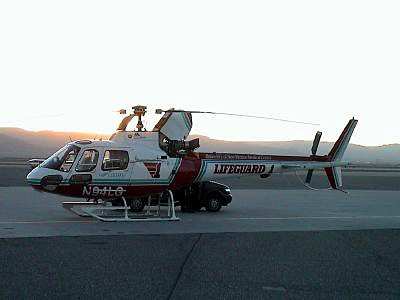
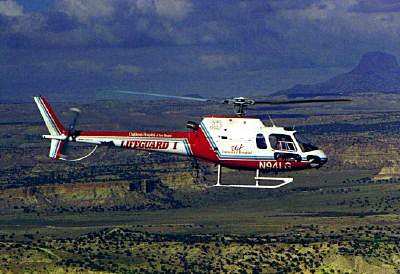
No one else was aboard the Eurocopter AS350-B3 A-Star helicopter, and the condition of the helicopter was not known at press time. The file photo seen here shows one of the UNM fleet. Three A-Stars are in use, one in Taos, one in Grants, and one in Albequerque.

The FAA is investigating the accident. So far, heavy snows have prevented investigators from reaching the crash site.

UNM's lifeguard fleet is managed by PHI. The hospital's website notes that its flight crew members have a total of 557 years of experience, and that's 16 years per individual on average.

Life flight operations are one of the riskiest ops in general aviation, despite the extreme professionalism of most operators, just because of the many inherent risk factors: low-visibility operations, unprepared landing zones, and life-in-the-balance pressure. Many of the crews have internalized the old Coast Guard life saving code: "You have to go out, but you don't have to come back."

It was always the greatest dream of Igor Sikorsky that his invention would be used for saving lives, and he always thrilled to news of helicopters saving lives, and kept a scrapbook of such rescues all his life. Our congratulations to Neal, on living to save lives again.

FMI: www.hsc.unm.edu/lifeguard

Advertisement

More News

ANN's Daily Aero-Term (11.28.25): Unmanned Aircraft System (UAS)

Unmanned Aircraft System (UAS) An unmanned aircraft and its associated elements related to safe operations, which may include control stations (ground, ship, or air based), control>[...]

ANN's Daily Aero-Linx (11.28.25)

Aero Linx: Cactus Fly-In The Classic Airplane Association of Arizona, Inc. (CAAA) was incorporated in Arizona as a not for profit corporation on January 10, 2014. The CAAA roster i>[...]

Airborne 11.21.25: NTSB on UPS Accident, Shutdown Protections, Enstrom Update

Also: UFC Buys Tecnams, Emirates B777-9 Buy, Allegiant Pickets, F-22 And MQ-20 The NTSB's preliminary report on the UPS Flight 2976 crash has focused on the left engine pylon's sep>[...]

Airborne 11.26.25: Bonanza-Baron Fini, Archer v LA NIMBYs, Gogo Loses$$$

Also: Bell 505 on SAF, NYPA Gets Flak For BizAv 'Abuse', FAA Venezuela Caution, Horizon Update Textron Aviation has confirmed it will be ending production of the Beechcraft Bonanza>[...]

Airborne-NextGen 11.25.25: EHang Manned Flt, Army UAVs, Starship V3 Booster Boom

Also: FedEx SAF, Archer Midnight Powertrain Tech, Rocket Lab Record, Perseverance Rover Find EHang has logged a major milestone in the development of its pilotless air taxi, loggin>[...]

blog comments powered by Disqus



Advertisement

Advertisement

Podcasts

Advertisement

© 2007 - 2025 Web Development & Design by Pauli Systems, LC

