
Raytheon System Helps Pilots Fly Drones Beyond Line Of Sight | Aero-News Network
Aero-News Network
RSS icon RSS feed
podcast icon MP3 podcast
Subscribe Aero-News e-mail Newsletter Subscribe

Airborne Unlimited -- Most Recent Daily Episodes

Episode Date

Airborne-Monday

Airborne-Tuesday

Airborne-Wednesday Airborne-Thursday

Airborne-Friday

Airborne On YouTube

Airborne-Unlimited-12.01.25

AirborneNextGen-
11.18.25

Airborne-Unlimited-11.19.25

Airborne-AffordableFlyers-11.20.25

AirborneUnlimited-11.21.25

LIVE MOSAIC Town Hall (Archived): www.airborne-live.net

Wed, May 01, 2019

Raytheon System Helps Pilots Fly Drones Beyond Line Of Sight

Eliminates Need For Chase Planes And Ground Observers In New FAA-Approved Ohio Drone Test Site

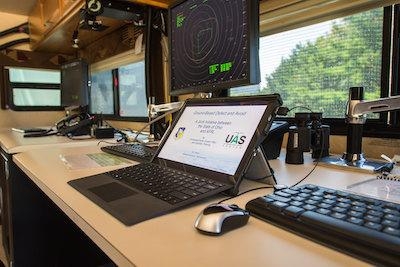
Raytheon's Ground Based Detect and Avoid (GBDAA) system is now operational at Springfield-Beckley Municipal Airport and will be used to test the safety and efficiency of small drone operations in the 200 square mile drone test range.

"GBDAA allows drone pilots to make safe decisions about flight maneuvers beyond visual line of sight without using ground observers or chase planes," said Matt Gilligan, vice president of Raytheon's Intelligence, Information and Services business. "The data gathered at this test site will go a long way toward ensuring the safe integration of drones throughout the national airspace system."

Contracted by the U.S. Air Force through the Department of Transportation's VOLPE center, GBDAA is a key component of SkyVision, the only mobile beyond visual line-of-sight system certified by the Federal Aviation Administration to provide drone operators with real-time aircraft display data, satisfying a key 'see and avoid' requirement.

SkyVision operators inside the mobile unit will give drone pilots situational awareness and proximity alerts by syncing their display with the drone pilot's display, allowing for safe passage through the airspace by showing airborne tracks from multiple sensors.

GBDAA is based on Raytheon's Standard Terminal Automation Replacement System, or STARS, which is used by air traffic controllers at more than 400 FAA and military locations to provide safe aircraft spacing and sequencing guidance for departing and arriving aircraft.

GBDAA comes in numerous configurations to meet varying mission needs; the U.S. military uses a fixed version to manage larger unmanned systems like the Predator, Reaper, and Global Hawk.

(Source: Raytheon news release)

FMI: www.raytheon.com

Advertisement

More News

ANN's Daily Aero-Term (11.28.25): Unmanned Aircraft System (UAS)

Unmanned Aircraft System (UAS) An unmanned aircraft and its associated elements related to safe operations, which may include control stations (ground, ship, or air based), control>[...]

ANN's Daily Aero-Linx (11.28.25)

Aero Linx: Cactus Fly-In The Classic Airplane Association of Arizona, Inc. (CAAA) was incorporated in Arizona as a not for profit corporation on January 10, 2014. The CAAA roster i>[...]

Airborne 11.21.25: NTSB on UPS Accident, Shutdown Protections, Enstrom Update

Also: UFC Buys Tecnams, Emirates B777-9 Buy, Allegiant Pickets, F-22 And MQ-20 The NTSB's preliminary report on the UPS Flight 2976 crash has focused on the left engine pylon's sep>[...]

Airborne 11.26.25: Bonanza-Baron Fini, Archer v LA NIMBYs, Gogo Loses$$$

Also: Bell 505 on SAF, NYPA Gets Flak For BizAv 'Abuse', FAA Venezuela Caution, Horizon Update Textron Aviation has confirmed it will be ending production of the Beechcraft Bonanza>[...]

Airborne-NextGen 11.25.25: EHang Manned Flt, Army UAVs, Starship V3 Booster Boom

Also: FedEx SAF, Archer Midnight Powertrain Tech, Rocket Lab Record, Perseverance Rover Find EHang has logged a major milestone in the development of its pilotless air taxi, loggin>[...]

blog comments powered by Disqus



Advertisement

Advertisement

Podcasts

Advertisement

© 2007 - 2025 Web Development & Design by Pauli Systems, LC

