
U.S. Marine Corps Has An Aviation Plan | Aero-News Network
Aero-News Network
RSS icon RSS feed
podcast icon MP3 podcast
Subscribe Aero-News e-mail Newsletter Subscribe

Airborne Unlimited -- Most Recent Daily Episodes

Episode Date

Airborne-Monday

Airborne-Tuesday

Airborne-Wednesday Airborne-Thursday

Airborne-Friday

Airborne On YouTube

Airborne-Unlimited-12.01.25

AirborneNextGen-
11.18.25

Airborne-Unlimited-11.19.25

Airborne-AffordableFlyers-11.20.25

AirborneUnlimited-11.21.25

LIVE MOSAIC Town Hall (Archived): www.airborne-live.net

Fri, May 13, 2022

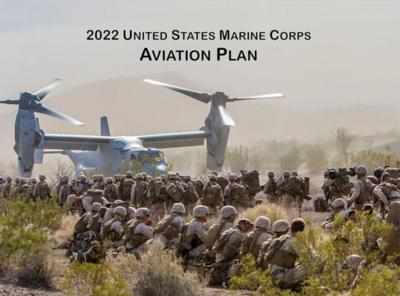
U.S. Marine Corps Has An Aviation Plan

U.S. Marine Corps (USMC) Has A Plan For Aviation ‘Force Design 2030’

In a 200+ page document, the USMC’s Deputy Commandant for Aviation, Lt Gen Mark R. Wise outlined what they deemed an aggressive plan to evolve the USMC’s aviation division to play a key role in the force’s future. The ‘Force Design 2030’ is a roadmap they hope will help them transition the USMC into “a more agile expeditionary force.” The doctrine serves as a foundation to describe the forward-looking desired capabilities and concepts that will continue to provide a “warfighting advantage.”

‘Force Design 2030’ not only addresses its land, sea, and airborne assets, but also the human side, restructuring the organizational hierarchy from a linear to functional capabilities-based divisions, while moving away from a hierarchical system to a dynamic one in an effort to achieve greater agility, essentially decentralized units with decision-making authority at the lowest levels. The Force Design 2030 promises operation from austere distributed locations…across extended distances…minimally sustained…fully networked…and interoperable with the Join Force, America’s allies and partners.”

The plan uses the Cunningham Group Organizational structure, a 3-division unit that supports the assessment and planning for the USMC Aviation: 1) Future Capabilities, 2) Strategy & Wargaming, and 3) Operational Readiness, and it appears that the functional capabilities are aligned according to these three areas. In an interesting twist, their construction plan represents a philosophical shift from purpose-built to standard-built, which facilitates agility in unit laydown and deployments while also reducing dependency on specific home-basing locations, but more importantly, improve cost and resiliency.

FMI: https://marines.mil

Advertisement

More News

ANN's Daily Aero-Term (11.29.25): Waypoint

Waypoint A predetermined geographical position used for route/instrument approach definition, progress reports, published VFR routes, visual reporting points or points for transiti>[...]

ANN's Daily Aero-Linx (11.29.25)

Aero Linx: Sentimental Journey to Cub Haven Sentimental Journey Flyin began in 1986 with a group of dedicated volunteers working to provide a sentimental return to Lock Haven, the >[...]

NTSB Prelim: Jabiru USA Sport Aircraft LLC J230-SP

The Pilot Would Often Fly Over Their House At A Low Altitude And That Family Members Would Go Outside To Wave On November 14, 2025, at 1708 eastern standard time, a Jabiru USA Spor>[...]

Classic Aero-TV: Crafting The Future of eVTOL Infrastructure

From 2024 (YouTube Edition): Volatus Infrastructure Paves The Way The name “Volatus” seems to be everywhere these days, popping up in a series of partnerships and proje>[...]

Klyde Morris (11.28.25)

Fortnite Conquers All, Klyde FMI: www.klydemorris.com>[...]

blog comments powered by Disqus



Advertisement

Advertisement

Podcasts

Advertisement

© 2007 - 2025 Web Development & Design by Pauli Systems, LC

