
Feds Push Airlines To Replace Aging Insulation | Aero-News Network
Aero-News Network
RSS icon RSS feed
podcast icon MP3 podcast
Subscribe Aero-News e-mail Newsletter Subscribe

Airborne Unlimited -- Most Recent Daily Episodes

Episode Date

Airborne-Monday

Airborne-Tuesday

Airborne-Wednesday Airborne-Thursday

Airborne-Friday

Airborne On YouTube

Airborne-Unlimited-12.01.25

AirborneNextGen-
12.02.25

Airborne-Unlimited-12.03.25

Airborne-FltTraining-12.04.25

AirborneUnlimited-12.05.25

AFE 2025 LIVE MOSAIC Town Hall (Archived): www.airborne-live.net

Mon, Mar 07, 2005

Feds Push Airlines To Replace Aging Insulation

Now How Much Will You Pay? But Wait!

Beset with huge losses attributable to high costs and low fares, the airline industry now has something else to worry about: the aging insulation on some aircraft.

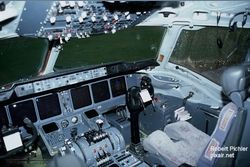
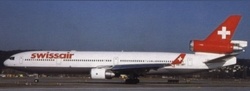
As ANN reported last year, the issue is strongly linked to the destruction of Swiss Air 111, a McDonnell Douglas MD-11 that went down in the ocean off the coast of Nova Scotia in 1998. A complicated Canadian Transport Board investigation showed the aircraft's inflight entertainment network ignited a fire in the aircraft's insulation just above the cockpit, filling the flight deck with toxic smoke and eventually leading to the aircraft's demise.

The TSB found:

"Reconstruction of the wreckage indicated that a segment of arced electrical cable associated with the in-flight entertainment network (IFEN) had been located in the area where the fire most likely originated. The Board concluded that the arc on this electrical cable was likely associated with the fire initiation event. The Board also concluded that it is likely that one or more additional wires were involved in the lead arcing event, and that the additional wire or wires could have been either IFEN or aircraft wires. Therefore, it could not be concluded that the known arcing event on the IFEN cable located in the area where the fire most likely originated was by itself the lead event."

Based in part on that finding, the NTSB in Washington has ordered the metalized Mylar insulation replaced on all MD-80, MD-88, MD-90, DC-10 and MD-11 aircraft by June 30th. The FAA estimates cost of retrofitting the 719 aircraft that fall under the mandate at $368.4 million.

"Any expense right now is bad timing for airlines, since most of them are in a cash crunch," Calyon Securities analyst Ray Neidl told Reuters. "But safety comes first."

FMI: www.ntsb.gov

Advertisement

More News

ANN's Daily Aero-Term (12.04.25): Cooperative Surveillance

Cooperative Surveillance Any surveillance system, such as secondary surveillance radar (SSR), wide-area multilateration (WAM), or ADS-B, that is dependent upon the presence of cert>[...]

ANN's Daily Aero-Linx (12.04.25)

Aero Linx: OX5 Aviation Pioneers Incorporated in 1955 as a Pa 501 (c)(3) Not for Profit Corporation, the OX5 Aviation Pioneers is dedicated to bringing before the public the accomp>[...]

NTSB Prelim: Extra Flugzeugproduktions EA 300/SC

The Pilot Appeared To Regain Control After Six Rotations And Attempted To “Fly Out” Inverted But Had Insufficient Altitude On November 8, 2025, at 1038 eastern standard>[...]

Classic Aero-TV: The Bally Bomber - The All Time Ultimate Warbird Replica?

From 2018 (YouTube Edition): Aero-News Talks With The Airplane's Builder One of the many unique airplanes at AirVenture 2018 was a 1/3-scale B-17 bomber built by Jack Bally, who ta>[...]

ANN's Daily Aero-Linx (12.05.25)

Aero Linx: Society of U.S. Army Flight Surgeons (SoUSAFS) The Society of US Army Flight Surgeons (SoUSAFS) serves to advance the science and art of Aerospace Medicine and its allie>[...]

blog comments powered by Disqus



Advertisement

Advertisement

Podcasts

Advertisement

© 2007 - 2025 Web Development & Design by Pauli Systems, LC

