
Osprey Completes Final Shipboard Developmental Testing | Aero-News Network
Aero-News Network
RSS icon RSS feed
podcast icon MP3 podcast
Subscribe Aero-News e-mail Newsletter Subscribe

Airborne Unlimited -- Most Recent Daily Episodes

Episode Date

Airborne-Monday

Airborne-Tuesday

Airborne-Wednesday Airborne-Thursday

Airborne-Friday

Airborne On YouTube

Airborne-Unlimited-12.01.25

AirborneNextGen-
12.02.25

Airborne-Unlimited-12.03.25

Airborne-FltTraining-12.04.25

AirborneUnlimited-12.05.25

AFE 2025 LIVE MOSAIC Town Hall (Archived): www.airborne-live.net

Tue, Dec 07, 2004

Osprey Completes Final Shipboard Developmental Testing

Important Step Toward Op Eval Next Year

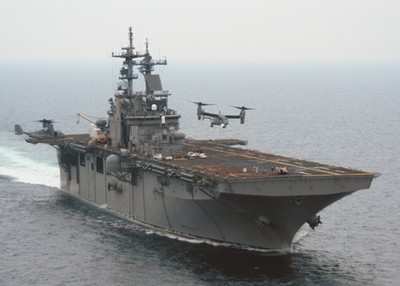
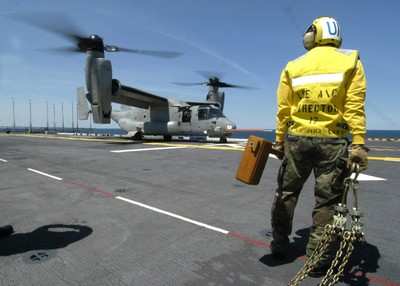
The V-22 Integrated Test Team conducted Shipboard Suitability Phase IVc for ten days beginning on November 12. This was the fourth and final underway period for the ITT since the program’s return to flight in May of 2002. Phase IVc’s successful completion was an important step on the path toward the Osprey’s operational evaluation early next year.

The primary objective of this phase was to complete interaction testing between a V-22 parked on the flight deck and another V-22 hovering in front of it. Additional test objectives included flight envelope expansion for all port side landing spots aboard the LHD, developing a night short takeoff envelope, and evaluating the latest flight control software version.

“The team was able to get a lot done during our time underway,” said Bill Geyer, the ITT’s lead shipboard suitability engineer. “The data we gathered will help us close the book on MV-22 shipboard developmental test. We’ve given the operational testers and, in turn, the fleet the tools for success at sea.”

While the ITT was busy working on the Wasp’s flight deck, a group of maintainers from VMX-22, the V-22 operational test and evaluation squadron based at MCAS New River, were in the hangar bay conducting maintenance demonstration testing. Tests included removing both engines, jacking the aircraft and cycling the landing gear, and removing prop-rotor hubs and blade assemblies. The VMX-22 team’s findings will serve them well during the squadron’s upcoming operational evaluation.

Geyer was quick to attribute the ITT’s success to their hosts. “The Wasp was excellent,” he said. “The bridge team went out of its way to get us the winds we needed, and the Air Department was always willing to go the extra mile to get the job done for us. Overall, it was the best experience I’ve ever had at sea while conducting tests.”

(ANN salutes Ward Carroll, NAVAIR Public Affairs)

FMI: www.navair.navy.mil

Advertisement

More News

ANN's Daily Aero-Term (12.04.25): Cooperative Surveillance

Cooperative Surveillance Any surveillance system, such as secondary surveillance radar (SSR), wide-area multilateration (WAM), or ADS-B, that is dependent upon the presence of cert>[...]

ANN's Daily Aero-Linx (12.04.25)

Aero Linx: OX5 Aviation Pioneers Incorporated in 1955 as a Pa 501 (c)(3) Not for Profit Corporation, the OX5 Aviation Pioneers is dedicated to bringing before the public the accomp>[...]

NTSB Prelim: Extra Flugzeugproduktions EA 300/SC

The Pilot Appeared To Regain Control After Six Rotations And Attempted To “Fly Out” Inverted But Had Insufficient Altitude On November 8, 2025, at 1038 eastern standard>[...]

Classic Aero-TV: The Bally Bomber - The All Time Ultimate Warbird Replica?

From 2018 (YouTube Edition): Aero-News Talks With The Airplane's Builder One of the many unique airplanes at AirVenture 2018 was a 1/3-scale B-17 bomber built by Jack Bally, who ta>[...]

ANN's Daily Aero-Linx (12.05.25)

Aero Linx: Society of U.S. Army Flight Surgeons (SoUSAFS) The Society of US Army Flight Surgeons (SoUSAFS) serves to advance the science and art of Aerospace Medicine and its allie>[...]

blog comments powered by Disqus



Advertisement

Advertisement

Podcasts

Advertisement

© 2007 - 2025 Web Development & Design by Pauli Systems, LC

