
Boeing Establishes Australian Simulator-Based Training For Kiowa Crews | Aero-News Network
Aero-News Network
RSS icon RSS feed
podcast icon MP3 podcast
Subscribe Aero-News e-mail Newsletter Subscribe

Airborne Unlimited -- Most Recent Daily Episodes

Episode Date

Airborne-Monday

Airborne-Tuesday

Airborne-Wednesday Airborne-Thursday

Airborne-Friday

Airborne On YouTube

Airborne-Unlimited-12.01.25

AirborneNextGen-
12.02.25

Airborne-Unlimited-12.03.25

Airborne-FltTraining-12.04.25

AirborneUnlimited-12.05.25

AFE 2025 LIVE MOSAIC Town Hall (Archived): www.airborne-live.net

Tue, Aug 07, 2012

Boeing Establishes Australian Simulator-Based Training For Kiowa Crews

Helicrew Helicopter Simulator Enables Instructors To Safely And Cost-Efficiently Enhance Skills, Plan Exercises

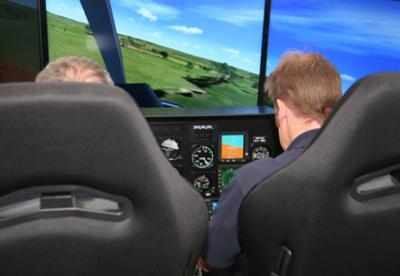
A Helicrew simulator has been installed at the Oakey Army Aviation Training Center in Queensland, Australia by Boeing Defence Australia (BDA) to enhance the capabilities of BDA flight instructors. The Helicrew allows BDA Qualified Flying Instructors to further hone and test their training procedures through a variety of simulated situations. Helicrew is designed to replicate the Bell 206B-1 Kiowa, which the Australian Army uses as an initial training helicopter before pilots transition to operational rotorcraft.

Through the Army Aviation Training and Training Support (AATTS) contract awarded in 2007, Boeing supports the Army's Kiowa, Black Hawk and CH-47 Chinook helicopters with pilot, aircrew and technician training, operational fleet maintenance, and support services. "Our investment in the Helicrew shows our ongoing commitment to supplying industry-leading, in-country instruction to align with the future of rotary wing training," said Mark Brownsey, AATTS project manager for BDA. "As we mature this synthetic capability, we will work with our customer on opportunities to use the Helicrew to provide some pilot instruction in a more cost-effective, lower-risk environment than flying real Kiowas."
 
"The Helicrew gives us the flexibility to plan training exercises much more quickly than before," said Charlie Stone, chief pilot at AATTS. "It also allows us to better prepare for emergencies in a safe environment, and to assess our performance at any point of the exercise – all of which will ultimately benefit pilots in training."

(Image provided by Boeing)

FMI: www.boeing.com

Advertisement

More News

ANN's Daily Aero-Term (12.04.25): Cooperative Surveillance

Cooperative Surveillance Any surveillance system, such as secondary surveillance radar (SSR), wide-area multilateration (WAM), or ADS-B, that is dependent upon the presence of cert>[...]

ANN's Daily Aero-Linx (12.04.25)

Aero Linx: OX5 Aviation Pioneers Incorporated in 1955 as a Pa 501 (c)(3) Not for Profit Corporation, the OX5 Aviation Pioneers is dedicated to bringing before the public the accomp>[...]

NTSB Prelim: Extra Flugzeugproduktions EA 300/SC

The Pilot Appeared To Regain Control After Six Rotations And Attempted To “Fly Out” Inverted But Had Insufficient Altitude On November 8, 2025, at 1038 eastern standard>[...]

Classic Aero-TV: The Bally Bomber - The All Time Ultimate Warbird Replica?

From 2018 (YouTube Edition): Aero-News Talks With The Airplane's Builder One of the many unique airplanes at AirVenture 2018 was a 1/3-scale B-17 bomber built by Jack Bally, who ta>[...]

ANN's Daily Aero-Linx (12.05.25)

Aero Linx: Society of U.S. Army Flight Surgeons (SoUSAFS) The Society of US Army Flight Surgeons (SoUSAFS) serves to advance the science and art of Aerospace Medicine and its allie>[...]

blog comments powered by Disqus



Advertisement

Advertisement

Podcasts

Advertisement

© 2007 - 2025 Web Development & Design by Pauli Systems, LC

