
NASA's Clean Rooms Are... Well, Not So Much | Aero-News Network
Aero-News Network
RSS icon RSS feed
podcast icon MP3 podcast
Subscribe Aero-News e-mail Newsletter Subscribe

Airborne Unlimited -- Most Recent Daily Episodes

Episode Date

Airborne-Monday

Airborne-Tuesday

Airborne-Wednesday Airborne-Thursday

Airborne-Friday

Airborne On YouTube

Airborne-Unlimited-12.01.25

AirborneNextGen-
12.02.25

Airborne-Unlimited-12.03.25

Airborne-FltTraining-12.04.25

AirborneUnlimited-12.05.25

AFE 2025 LIVE MOSAIC Town Hall (Archived): www.airborne-live.net

Thu, Sep 06, 2007

NASA's Clean Rooms Are... Well, Not So Much

Some Earth Bacteria Hardy Enough To Survive Harsh Environments

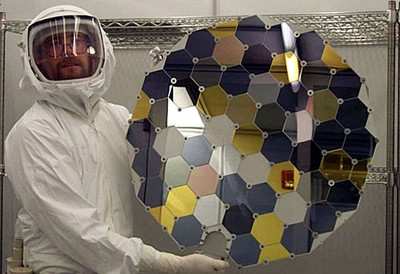
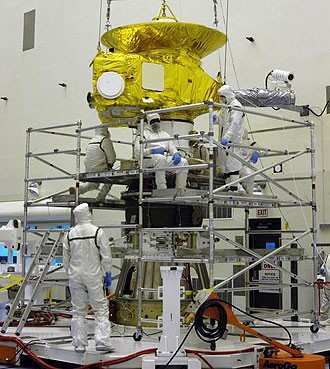
The clean rooms used by the National Aeronautics and Space Administration to assemble spacecraft aren't as clean as one would think.

According to Nature, samples taken from the Jet Propulsion Laboratory, Kennedy Space Center and Johnson Space Center show some pretty hardy bacteria that have managed to not only survive the harsh cleaning processes with harsh cleansers and ultraviolet light, but actually thrive.

This isn't surprising to some.

"The rooms are not sterile," says Michel Viso, an astrobiologist at the French space agency CNES in Paris.

Researchers the JPL facility at the California Institute of Technology, Pasadena, found each of the three sites possessed very different bacterial communities. They discovered strains in the spore-forming Bacillus family that had never been seen before as well as some extremophile bacteria that thrive in extreme conditions, like Methylobacterium, which is resistant to high levels of chlorine.

"It is, by nature, an extreme environment; it's not surprising that extremophiles exist there," says John Rummel, senior scientist for astrobiology at NASA headquarters, Washington DC, of the clean rooms.

Researchers catalogued the bacteria found to compare against anything brought back on space missions. This will help determine if any extraterrestrial bacteria is actually being encountered, or merely a stowaway of sorts that managed to survive the trip.

"We now understand a little better what type of [Earthly] organisms we're dealing with," says Catharine Conley, NASA's planetary protection officer.

There are strict national and international regulations, such as the Outer Space Treaty of 1967, about what can and cannot be released into space 

It is unlikely any bacteria would be tough enough to survive on Mars, though.

"UV radiation kills everything over a period of time anyway," said Rummel.

FMI: www.jpl.nasa.gov, www.jsc.nasa.gov, www.ksc.nasa.gov

Advertisement

More News

ANN's Daily Aero-Linx (12.03.25)

Aero Linx: American Aviation Historical Society AAHS is dedicated to the preservation and dissemination of the rich heritage of American aviation. Our purpose is to collect, preser>[...]

ANN's Daily Aero-Term (12.03.25): CrewMember (UAS)

CrewMember (UAS) A person assigned to perform an operational duty. A UAS crewmember includes the remote pilot in command, the person manipulating the controls, and visual observers>[...]

NTSB Prelim: Maule M-7-235A

Immediately After The Right Main Tire Contacted The Runway Surface, The Right Main Landing Gear Failed On October 31, 2025, at about 1227 Pacific daylight time, a Maule M-7-235A, N>[...]

Airborne-Flight Training 12.04.25: Ldg Fee Danger, Av Mental Health, PC-7 MKX

Also: IAE Acquires Diamond Trainers, Army Drones, FedEx Pilots Warning, DA62 MPP To Dresden Tech Uni The danger to the flight training industry and our future pilots is clear. Dona>[...]

Aero-News: Quote of the Day (12.04.25)

"On December 3, 2025, at approximately 10:45 a.m., a Thunderbird pilot ejected safely from a F-16C Fighting Falcon aircraft during a training mission over controlled airspace in Ca>[...]

blog comments powered by Disqus



Advertisement

Advertisement

Podcasts

Advertisement

© 2007 - 2025 Web Development & Design by Pauli Systems, LC

