

Naval Research Lab Develops Fully Autonomous Compact Electric Helo | Aero-News Network
Aero-News Network
RSS icon RSS feed
podcast icon MP3 podcast
Subscribe Aero-News e-mail Newsletter Subscribe

Airborne Unlimited -- Most Recent Daily Episodes

Episode Date

Airborne-Monday

Airborne-Tuesday

Airborne-Wednesday Airborne-Thursday

Airborne-Friday

Airborne On YouTube

Airborne-Unlimited-12.01.25

AirborneNextGen-
12.02.25

Airborne-Unlimited-12.03.25

Airborne-FltTraining-12.04.25

AirborneUnlimited-12.05.25

AFE 2025 LIVE MOSAIC Town Hall (Archived): www.airborne-live.net

Wed, Sep 07, 2005

Naval Research Lab Develops Fully Autonomous Compact Electric Helo

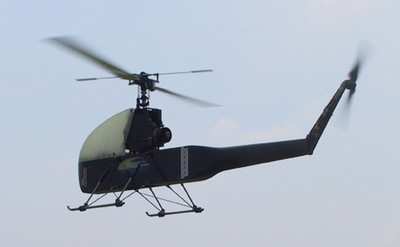
Researchers at the Naval Research Laboratory’s (NRL’s) Tactical Electronic Warfare Division (TEWD) have developed an affordably expendable fully autonomous compact electric helicopter system called SPIDER (Scientific Payload Insertion Device Electric Rotor). The helicopter can perform automatic takeoffs, fly up to 50 mph for 30 minutes, hover over a precise location and land autonomously while carrying a 4 pound scientific or countermeasures payload.

According to Mr. Chris Bovais, the SPIDER program manager, “The air vehicle and autopilot flight testing program began at NRL in June 2004. The NRL team implemented autopilot algorithms that were based on a neural adaptive flight controller system. This developmental software was first tested extensively on a surrogate electric model helicopter before being integrated into the new Cloud Cap Technology Piccolo II autopilot for use in the SPIDER system. The addition of an Aerosonde packaged Iridium data modem provides the capability for performing operations beyond RF line of sight communication, enhancing the overall mission capabilities of the helicopter.”

The research team reports the SPIDER prototype has successfully completed 97 flights during developmental testing achieving flight speeds of 50 mph. “The wide-speed range and accurate hovering performance that the NRL team has achieved from this small, low-cost avionics package is a major technology advancement,” Mr. Bovais said.

“SPIDER is a unique system because it is a small, inexpensive, electric helicopter that fits into an easily transportable case, can operate from unimproved terrain and requires no special helicopter pilot training to operate,” Mr. Bovais concluded.

FMI: www.nrl.navy.mil

Advertisement

More News

ANN's Daily Aero-Term (12.04.25): Cooperative Surveillance

Cooperative Surveillance Any surveillance system, such as secondary surveillance radar (SSR), wide-area multilateration (WAM), or ADS-B, that is dependent upon the presence of cert>[...]

ANN's Daily Aero-Linx (12.04.25)

Aero Linx: OX5 Aviation Pioneers Incorporated in 1955 as a Pa 501 (c)(3) Not for Profit Corporation, the OX5 Aviation Pioneers is dedicated to bringing before the public the accomp>[...]

NTSB Prelim: Extra Flugzeugproduktions EA 300/SC

The Pilot Appeared To Regain Control After Six Rotations And Attempted To “Fly Out” Inverted But Had Insufficient Altitude On November 8, 2025, at 1038 eastern standard>[...]

Classic Aero-TV: The Bally Bomber - The All Time Ultimate Warbird Replica?

From 2018 (YouTube Edition): Aero-News Talks With The Airplane's Builder One of the many unique airplanes at AirVenture 2018 was a 1/3-scale B-17 bomber built by Jack Bally, who ta>[...]

ANN's Daily Aero-Linx (12.05.25)

Aero Linx: Society of U.S. Army Flight Surgeons (SoUSAFS) The Society of US Army Flight Surgeons (SoUSAFS) serves to advance the science and art of Aerospace Medicine and its allie>[...]

blog comments powered by Disqus



Advertisement

Advertisement

Podcasts

Advertisement

© 2007 - 2025 Web Development & Design by Pauli Systems, LC

