
Embraer Delivers 1,300th Ipanema Agplane | Aero-News Network
Aero-News Network
RSS icon RSS feed
podcast icon MP3 podcast
Subscribe Aero-News e-mail Newsletter Subscribe

Airborne Unlimited -- Most Recent Daily Episodes

Episode Date

Airborne-Monday

Airborne-Tuesday

Airborne-Wednesday Airborne-Thursday

Airborne-Friday

Airborne On YouTube

Airborne-Unlimited-12.08.25

AirborneNextGen-
12.02.25

Airborne-Unlimited-12.03.25

Airborne-FltTraining-12.04.25

AirborneUnlimited-12.05.25

AFE 2025 LIVE MOSAIC Town Hall (Archived): www.airborne-live.net

Thu, Dec 19, 2013

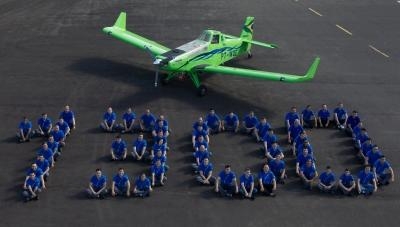
Embraer Delivers 1,300th Ipanema Agplane

Milestone Airplane Goes To Fort Aviação Agrícola

The Ipanema agricultural airplane has achieved a historic 1,300 units delivered. After more than 40 years of uninterrupted production, the aircraft continues being a best-seller: in 2012, 66 Ipanemas were sold to customers in Brazil and the Mercosur community, for an increase of 12% over the previous year (58 airplanes). The forecast for this year is that 70 aircraft will be delivered.

“The perpetuity of the Ipanema program is based on its reliability and efficiency,” says Fábio Bertoldi Carretto, Embraer’s Sales Manager for the Ipanema. “Over the years, improvements and advances have been incorporated, aligned with the needs and demands of customers, which has ensured the aircraft’s leadership position in its market segment.”

The commemorative aircraft is the eighth delivered to Fort Aviação Agrícola since 2007, when the company was founded, with headquarters in the city of Rio Verde, in outstate Goiás. “We work only with Ipanema airplanes, because we opted for a nationally built aircraft which is more appropriate for the working conditions and climate found in Brazil,” states Clertan Alves Macedo, Executive Director of Fort Aviação Agrícola, which has recently become the first company in its segment to receive ISO 9001 certification in the country’s Midwest. “Furthermore, we chose models powered by ethanol, which has a smaller environmental footprint, higher work output, and lower operating cost.”
 
The Ipanema was the first aircraft produced in series in the world to leave the factory already certified to fly on ethanol (hydrous ethanol), which is the same fuel used in automobiles – the model has been available since 2005. This alternative source of renewable fuel, derived from sugarcane, reduced its environmental footprint, lowered operating and maintenance costs, and improved the overall performance of the aircraft, making it more attractive to the market. Today, about 40% of the fleet in operation is powered by ethanol, and approximately 80% of the new airplanes are sold with this configuration.

(Image provided by Embraer)

FMI: www.embraer.com

Advertisement

More News

NTSB Final Report: Patriot Aircraft LLC CX1900A

After Draining Both Wing Fuel Tanks, A Significant Amount Of Water Was Observed In The Right Wing Fuel Tank Analysis: The pilot, who was also the owner of the experimental amateur->[...]

Aero-News: Quote of the Day (12.06.25)

“Airbus apologises for any challenges and delays caused to passengers and airlines by this event. The Company thanks its customers, the authorities, its employees and all rel>[...]

ANN's Daily Aero-Term (12.06.25): High Speed Taxiway

High Speed Taxiway A long radius taxiway designed and provided with lighting or marking to define the path of aircraft, traveling at high speed (up to 60 knots), from the runway ce>[...]

ANN's Daily Aero-Linx (12.06.25)

Aero Linx: Taylorcraft Foundation, Inc. The Taylorcraft Foundation is exclusively organized for charitable, educational & scientific activities and will preserve the history an>[...]

Airborne-NextGen 12.02.25: Honda eVTOL, Arctus High-Alt UAS, Samson Patent

Also: USAF Reaper Accident, Baikonur Damage, Horizon eVTOL IFR/FIKI, New Glenn Update Honda has outlined its clearest timeline yet for its entry into the world of electric vertical>[...]

blog comments powered by Disqus



Advertisement

Advertisement

Podcasts

Advertisement

© 2007 - 2025 Web Development & Design by Pauli Systems, LC

