
Cassini Spies The Ice-Giant Planet Uranus | Aero-News Network
Aero-News Network
RSS icon RSS feed
podcast icon MP3 podcast
Subscribe Aero-News e-mail Newsletter Subscribe

Airborne Unlimited -- Most Recent Daily Episodes

Episode Date

Airborne-Monday

Airborne-Tuesday

Airborne-Wednesday Airborne-Thursday

Airborne-Friday

Airborne On YouTube

Airborne-Unlimited-12.01.25

AirborneNextGen-
12.02.25

Airborne-Unlimited-12.03.25

Airborne-FltTraining-12.04.25

AirborneUnlimited-12.05.25

AFE 2025 LIVE MOSAIC Town Hall (Archived): www.airborne-live.net

Tue, May 06, 2014

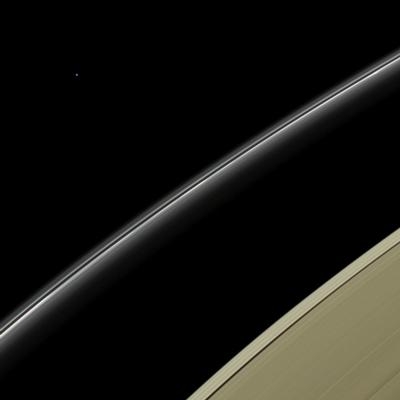
Cassini Spies The Ice-Giant Planet Uranus

Seen In The Distance Beyond Saturn's Rings

NASA's Cassini spacecraft has captured its first-ever image of the pale blue ice-giant planet Uranus in the distance beyond Saturn’s rings.

The robotic spacecraft briefly turned its gaze away from the ringed beauty of Saturn on April 11, 2014, to observe the distant planet, which is the seventh planet from the sun.

The planets Uranus and Neptune are sometimes referred to as “ice giants” to distinguish them from their larger siblings, Jupiter and Saturn, the classic "gas giants." The moniker derives from the fact that a comparatively large part of the planets’ composition consists of water, ammonia and methane, which are typically frozen as ices in the cold depths of the outer solar system. Jupiter and Saturn are made almost entirely of hydrogen and helium, with smaller percentages of these ices.

When this view was obtained, Uranus was nearly on the opposite side of the sun as seen from Saturn, at a distance of approximately 28.6 astronomical units from Cassini and Saturn. An astronomical unit is the average distance from Earth to the sun, equal to 93 million miles. At their closest – once during each Saturn orbit of nearly 30 years – the two planets approach to within about 10 astronomical units of each other.

In addition to its aesthetic appeal, Cassini’s view of Uranus also serves a practical purpose. Scientists working on several of Cassini’s science investigations expect that they will be able to use images and spectra from these observations to help calibrate their own instruments.

(Image provided by NASA)

FMI: www.nasa.gov

Advertisement

More News

ANN's Daily Aero-Linx (12.03.25)

Aero Linx: American Aviation Historical Society AAHS is dedicated to the preservation and dissemination of the rich heritage of American aviation. Our purpose is to collect, preser>[...]

ANN's Daily Aero-Term (12.03.25): CrewMember (UAS)

CrewMember (UAS) A person assigned to perform an operational duty. A UAS crewmember includes the remote pilot in command, the person manipulating the controls, and visual observers>[...]

NTSB Prelim: Maule M-7-235A

Immediately After The Right Main Tire Contacted The Runway Surface, The Right Main Landing Gear Failed On October 31, 2025, at about 1227 Pacific daylight time, a Maule M-7-235A, N>[...]

Airborne-Flight Training 12.04.25: Ldg Fee Danger, Av Mental Health, PC-7 MKX

Also: IAE Acquires Diamond Trainers, Army Drones, FedEx Pilots Warning, DA62 MPP To Dresden Tech Uni The danger to the flight training industry and our future pilots is clear. Dona>[...]

Aero-News: Quote of the Day (12.04.25)

"On December 3, 2025, at approximately 10:45 a.m., a Thunderbird pilot ejected safely from a F-16C Fighting Falcon aircraft during a training mission over controlled airspace in Ca>[...]

blog comments powered by Disqus



Advertisement

Advertisement

Podcasts

Advertisement

© 2007 - 2025 Web Development & Design by Pauli Systems, LC

