Mon, May 02, 2016
Company Says Slowed Rotor/Compound Technologies Could Have Applications In The Unmanned Market
Carter Aviation Technologies, LLC (Carter) has explored interest in its Slowed Rotor/Compound (SR/C) technologies for Unmanned Aircraft Systems (UAS) in the past. Carter has formed teams and partnerships and even secured UAS study contracts with its SR/C technology, but has yet to produce a UAS demonstrator.
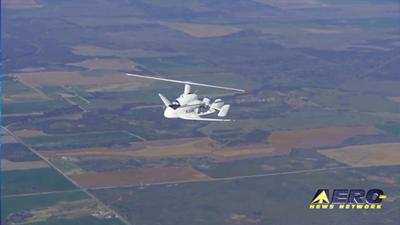
The same benefits of Carter’s technology that has been intriguing the manned aviation market is common with UAS applications – High efficiency enabling long range and high endurance, very quiet acoustic characteristics while loitering over an area of interest, in a simple, yet runway independent configuration, provides a compelling capability.
“We have understood the benefits of our technology for UAS missions for a long time, explained Jay Carter. “At one point in time we were selected by CENTCOM for a JCTD demonstration contract, but for a variety of reasons that project never came to fruition.” Carter is seeing increased interest in a long range, long endurance, runway independent UAS and intends to find a partner or partners with appropriate experience to pursue this business. “We recently responded to the Army’s Future Tactical Unmanned Aircraft System request for information,” stated Jay Carter. “This got our attention and as a result we have begun to rekindle past relationships as well as form new ones.”
Carter is attending the AUVSI symposium this year and among other meetings, Carter has been invited to brief the TRADOC Capability Manager for UAS regarding SR/C-based UAS concepts. “In addition to meeting with the Army, we are scheduling discussions with potential teammates,” described Jay Carter. “If the services are showing renewed interest in runway independent UAS, then this is something we cannot ignore.” Carter has had interest internationally and is currently seeking an export license for an SR/C-based UAS, but is now broadening its outreach to again include U.S. opportunities with the DoD.
Carter’s SR/C technology is scalable so it can be offered in a weight class similar to the RQ-7B Shadow UAV or provide a much larger platform with MQ-9 Reaper UAV capabilities, but without the need for launchers and recovery systems as is the case with the former or 5,000 ft plus runways in the case of the latter. Carter has developed several UAS concepts to include both jump takeoff and full hovering variants for missions ranging from cargo delivery to ISR and light strike.
(Source: Carter Aviation news release. Image from file)
More News
Unmanned Aircraft System (UAS) An unmanned aircraft and its associated elements related to safe operations, which may include control stations (ground, ship, or air based), control>[...]
Aero Linx: Cactus Fly-In The Classic Airplane Association of Arizona, Inc. (CAAA) was incorporated in Arizona as a not for profit corporation on January 10, 2014. The CAAA roster i>[...]
Also: UFC Buys Tecnams, Emirates B777-9 Buy, Allegiant Pickets, F-22 And MQ-20 The NTSB's preliminary report on the UPS Flight 2976 crash has focused on the left engine pylon's sep>[...]
Also: Bell 505 on SAF, NYPA Gets Flak For BizAv 'Abuse', FAA Venezuela Caution, Horizon Update Textron Aviation has confirmed it will be ending production of the Beechcraft Bonanza>[...]
Also: FedEx SAF, Archer Midnight Powertrain Tech, Rocket Lab Record, Perseverance Rover Find EHang has logged a major milestone in the development of its pilotless air taxi, loggin>[...]



 ANN's Daily Aero-Term (11.28.25): Unmanned Aircraft System (UAS)


 See All