Tue, Nov 02, 2010
First Multilateration System In Australia To Separate Aircraft
In Both En Route And Terminal Airspace
 The Wide Area Multilateration (WAM) system developed by Sensis
Corporation has passed its safety case by the Australian Civil
Aviation Safety Authority (CASA) and is now operational in airspace
covering Tasmania, Australia. The system uses both multilateration
and Automatic Dependent Surveillance - Broadcast (ADS-B) to provide
Airservices Australia with enhanced en route surveillance of air
traffic across the island and down to the surface at Hobart and
Launceston Airports. Sensis WAM's precise surveillance of aircraft
enables air traffic controllers to implement five nautical miles of
aircraft separation for safer, more efficient use of the airspace
in a region that was previously controlled with procedural
separation standards.
The Wide Area Multilateration (WAM) system developed by Sensis
Corporation has passed its safety case by the Australian Civil
Aviation Safety Authority (CASA) and is now operational in airspace
covering Tasmania, Australia. The system uses both multilateration
and Automatic Dependent Surveillance - Broadcast (ADS-B) to provide
Airservices Australia with enhanced en route surveillance of air
traffic across the island and down to the surface at Hobart and
Launceston Airports. Sensis WAM's precise surveillance of aircraft
enables air traffic controllers to implement five nautical miles of
aircraft separation for safer, more efficient use of the airspace
in a region that was previously controlled with procedural
separation standards.
"Sensis wide area multilateration was the most cost-effective
solution for surveillance over Tasmania today and also supports our
commitment to using ADS-B in the future," Airservices General
Manager, Technology and Asset Services, Alastair Hodgson said.
"This multimode approach is critical to ensuring safety and
airspace efficiency while ADS-B equipage grows."
Sensis WAM uses multiple low-maintenance, non-rotating sensors
to triangulate aircraft location based on transponder signals and
to provide air traffic controllers with precise aircraft position
and identification information, regardless of weather conditions.
With a higher update rate and greater positional accuracy than
traditional radar, Sensis WAM provides effective surveillance for
increased safety, capacity and efficiency of airspace and
airports.
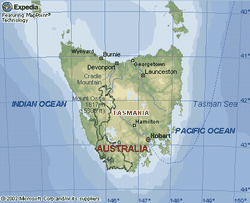
The Sensis WAM system provides cooperative surveillance coverage
between Launceston and Hobart Airports, with accurate coverage of
150 meters or better from the ground level at the airports to
18,000 feet. Surveillance data is sent to the Melbourne Air Traffic
Control Center where it will provide controllers with information
to implement five nautical miles of separation in an environment
that had largely been controlled with procedural separation
measures.
"With Sensis WAM, Air Navigation Service Providers can deploy a
cost-effective, highly-accurate system that is compatible with
current and future surveillance technologies and is an ideal
complement to ADS-B," said John Jarrell, vice president and general
manager of Sensis Air Traffic Systems. "The technology is also
enabling ANSPs to significantly enhance the efficiency of airspace
by reducing separation standards."
Sensis is providing WAM solutions to leading ANSPs and
militaries around the world, addressing terminal and en route
surveillance, precision runway monitoring and special use airspace
applications.
More News
Waypoint A predetermined geographical position used for route/instrument approach definition, progress reports, published VFR routes, visual reporting points or points for transiti>[...]
Aero Linx: Sentimental Journey to Cub Haven Sentimental Journey Flyin began in 1986 with a group of dedicated volunteers working to provide a sentimental return to Lock Haven, the >[...]
The Pilot Would Often Fly Over Their House At A Low Altitude And That Family Members Would Go Outside To Wave On November 14, 2025, at 1708 eastern standard time, a Jabiru USA Spor>[...]
From 2024 (YouTube Edition): Volatus Infrastructure Paves The Way The name “Volatus” seems to be everywhere these days, popping up in a series of partnerships and proje>[...]
Fortnite Conquers All, Klyde FMI: www.klydemorris.com>[...]



 ANN's Daily Aero-Term (11.29.25): Waypoint


 See All