Now Replacing Glass, Aluminum, Steel, And Titanium Parts
Considered one of the breakthrough innovations in the materials
sector, composites have gained increasing traction with their
capacity to enable aircraft weight reduction, according to analysis
from Frost & Sullivan. Their lightweight feature, offering fuel
efficiency, remains the primary factor-driving uptake of the
technology in the aerospace sector. Since the 1970s, composites
witnessed widespread adoption in the aerospace industry, replacing
pure glass, aluminum, steel and titanium-based parts. Composites
also manufacture easily on a large scale.

The new analysis shows that technology adoption in aerospace
occurs based on specific application needs. Changing value chain
relationships evolve into excellent opportunities for aerospace
companies. This associates with increased funding support for
extensive research in identifying new technologies.
"The Canadian, Australian and United States governments have
taken a proactive stance to promote environmental protection and
actively fund research in composites used in aerospace
applications," notes Technical Insights Research Analyst
Chandralekha. "In order to achieve fuel efficiency, big as well as
small participants in the aerospace sector are gradually increasing
the use of composites in different parts of aircraft."
Although composites were developed during the 1930s, their
applications were limited to making molds or dies for prototype
aircraft components and tooling for aircraft. These
first-of-their-kind composites consisted of glass fibers reinforced
with phenolic resins. During World War II, the applications of
these composites extended to fabrication of aircraft parts, such as
ducts (of diverse shapes), engine nacelles and radomes.
Despite the tangible benefits they offer, composites possess
some disadvantages that restrain market progression. Composites
replace metals in aircraft parts; however, repairing them involves
some technicalities, unlike metals. It is necessary to detect and
repair this damage as well as properly certify the product. Each
intricate stage requires expert knowledge, which is not readily
available. Issues such as delimitation of composites prove
difficult to detect and necessitate sensors and other complex
detection systems. On the contrary, any damage in metal parts mend
easily using the traditional welding technique.
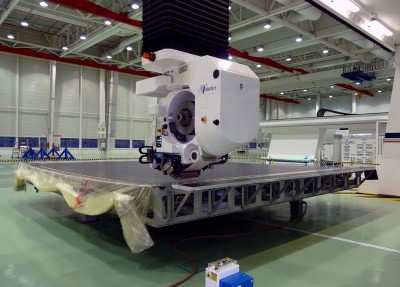
A350 XWB Composite Layup
To move market prospects forward, research efforts must elevate
to understand the properties of composites under normal as well as
stress conditions. It is also necessary to identify new testing and
damage detection systems. The results of such efforts provide
proper training and assistance to industrial participants. In
addition, this expands the expertise of maintenance, repair and
overhaul (MRO) companies with regard to composites. The market
witnessed a series of mergers and acquisitions (M&As) among
composite suppliers, distributors, parts manufacturers and original
equipment manufacturers. In light of the economic downturn,
governments expect to trim military budgets. Companies that
invested in military projects will currently be looking to enter
the commercial aviation sector through M&As.
"As composites and their applications provide growth prospects
in an already mature market, M&A's of private research bodies
and small companies provide a strategic entry point," says
Technical Insights Industry Analyst Krishna Venkataramani. "Such
initiatives lead to the integration of technology and product
expertise and result in durable and better performing aircraft
structures."



 Airborne 04.16.24: RV Update, Affordable Flying Expo, Diamond Lil

 See All