TL-Ultralight's Sirius Makes Its First Flight | Aero-News Network
Aero-News Network
RSS icon RSS feed
podcast icon MP3 podcast
Subscribe Aero-News e-mail Newsletter Subscribe

** AIRBORNE 06.18.13 Aero-TV-- CLICK HERE! ** HD iPad-Friendly Version -- AIRBORNE 06.18.13 **

** AIRBORNE 06.14.13 Aero-TV-- CLICK HERE! ** HD iPad-Friendly Version -- AIRBORNE 06.14.13**

** AIRBORNE 04.01.13 SPECIAL EDITION of Aero-TV-- CLICK HERE! ** HD iPad-Friendly Version -- AIRBORNE 04.01.13 SPECIAL EDITION **

Wed, Jun 25, 2008

TL-Ultralight's Sirius Makes Its First Flight

High-Wing LSA Was Introduced Last Year At OSH

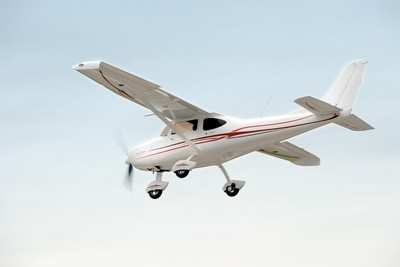
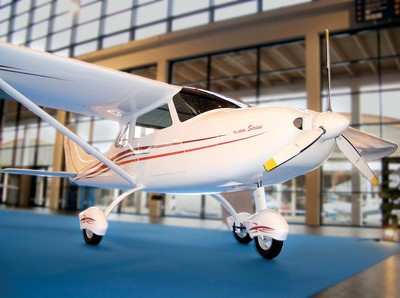
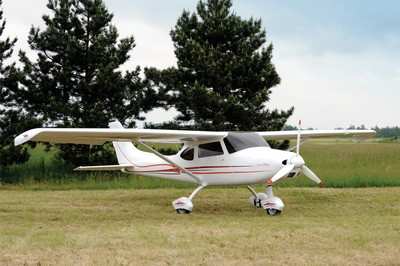
TL-Ultralight s.r.o. recently completed the first series of test flights of the high-wing TL-3000 Sirius in the Czech Republic.

The Sirius -- like the company's low-wing TL-2000 StingSport -- is a two passenger, carbon fiber fixed-wing airplane powered by the 100 hp Rotax 912ULS engine. It will be manufactured in versions for distribution in Europe and in the United States as a special light sport aircraft (SLSA). SportairUSA, LC, will distribute the airplane in North America.

Piloted by company president Jiri Tlusty, the first Sirius demonstrated lively acceleration and responsive slow flight characteristics in its initial flights.

"The airplane lifts off and very quickly achieves a rapid rate of climb." Tlusty said. "Our design and development team has produced a highwing sport airplane that will be a worthy complement to the Sting."

The project began in 2006 and was introduced in 2007 as a proof-of-concept model at air shows in
Friedrichshafen, Germany, and at AirVenture in the USA. A production prototype is targeted for
completion in July and tooling is underway for the first European production runs later this year.

The S-LSA version will be ready for the US market in the first half of 2009. Bill Canino, the President of SportairUSA, which also distributes the Sting S3, was in the Czech Republic for the initial flights.

"With the Sirius, TL-Ultralight once again demonstrates its deep experience and mastery of the design and construction benefits of carbon composite airframes," Canino said.

The Sirius is designed for a maximum gross weight of 1,320 pounds in its S-LSA version (1,430 pounds on floats), with a useful load of 600 pounds, and extended range with 30+ gallons of fuel. The cabin is 46 inches wide at the shoulders.

Standard equipment on the tricycle-geared airplane includes steerable nose gear, toe-actuated disc brakes, adjustable rudder pedals and a whole-plane GRS ballistic recovery parachute. Other features include easy entry/exit and generous cabin size with plenty of legroom.

The Sirius will be equipped for night flight and will comply with ASTM standards for IFR flight when those standards are issued. The instrument panel accommodates either a traditional six-pack arrangement of flight instruments or any of a variety of primary and multipurpose flight displays – from Dynon, Grand Rapids Technologies and TruTrak – along with a full complement of avionics.

FMI: www.sting.aero, www.sportair.aero

Advertisement

More News

Aero-TV: Garmin’s GNC-255 –- Back To Basics

Garmin's New Aviation VHF Radios Early this year, a new series of aviation VHF COM and NAV/COM radios, the GTR and GNC series, was announced by Garmin. As the replacement products >[...]

EADS And Siemens Enter Long-Term Research Partnership

Sign MoU With Diamond Aircraft On Electric Propulsion System EADS and Siemens are entering into a long-term research partnership to introduce new electric propulsion systems that c>[...]

ANN's Daily Aero-Term (06.19.13): Ceiling

The heights above the earth's surface of the lowest layer of clouds or obscuring phenomena that is reported as broken, overcast, or obscuration, and not classified as thin or parti>[...]

ANN's Daily Aero-Linx (06.19.13)

The Army Aviation Heritage Foundation The Army Aviation Heritage Foundation (AAHF) is a non-profit public educational foundation dedicated to presenting the Army Aviation story to >[...]

Aero-News: Quote Of The Day (06.19.13)

“The serial electric propulsion allows us to design airplanes with totally different characteristics than today. Vertical take-off and high-speed cruise can be realized in a >[...]

blog comments powered by Disqus


Advertisement

Advertisement

Podcasts

Advertisement

© 2007 - 2013 Web Development & Design by Pauli Systems, LC