Scientists Say Moon Is Pulling Apart Forming Small Valleys On
The Lunar Surface
New images from NASA's Lunar Reconnaissance Orbiter (LRO)
spacecraft show the moon's crust is being stretched, forming minute
valleys in a few small areas on the lunar surface. Scientists
propose this geologic activity occurred less than 50 million years
ago, which is considered recent compared to the moon's age of more
than 4.5 billion years.

A team of researchers analyzing high-resolution images obtained
by the Lunar Reconnaissance Orbiter Camera (LROC) show small,
narrow trenches typically much longer than they are wide. This
indicates the lunar crust is being pulled apart at these locations.
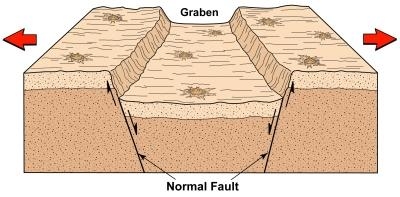
These linear valleys, known as graben, form when the moon's crust
stretches, breaks and drops down along two bounding faults. A
handful of these graben systems have been found across the lunar
surface.
"We think the moon is in a general state of global contraction
because of cooling of a still hot interior," said Thomas Watters of
the Center for Earth and Planetary Studies at the Smithsonian's
National Air and Space Museum in Washington, and lead author of a
paper on this research appearing in the March issue of the journal
Nature Geoscience. "The graben tell us forces acting to shrink the
moon were overcome in places by forces acting to pull it apart.
This means the contractional forces shrinking the moon cannot be
large, or the small graben might never form."
The weak contraction suggests that the moon, unlike the
terrestrial planets, did not completely melt in the very early
stages of its evolution. Rather, observations support an
alternative view that only the moon's exterior initially melted
forming an ocean of molten rock.
In August 2010, the team used LROC images to identify physical
signs of contraction on the lunar surface, in the form of
lobe-shaped cliffs known as lobate scarps. The scarps are evidence
the moon shrank globally in the geologically recent past and might
still be shrinking today. The team saw these scarps widely
distributed across the moon and concluded it was shrinking as the
interior slowly cooled.
Based on the size of the scarps, it is estimated that the
distance between the moon's center and its surface shrank by
approximately 300 feet. The graben were an unexpected discovery and
the images provide contradictory evidence that the regions of the
lunar crust are also being pulled apart.
"This pulling apart tells us the moon is still active," said
Richard Vondrak, LRO Project Scientist at NASA's Goddard Space
Flight Center in Greenbelt, MD. "LRO gives us a detailed look at
that process."
As the LRO mission progresses and coverage increases, scientists
will have a better picture of how common these young graben are and
what other types of tectonic features are nearby. The graben
systems the team finds may help scientists refine the state of
stress in the lunar crust.
"It was a big surprise when I spotted graben in the far side
highlands," said co-author Mark Robinson of the School of Earth and
Space Exploration at Arizona State University, principal
investigator of LROC. "I immediately targeted the area for
high-resolution stereo images so we could create a
three-dimensional view of the graben. It's exciting when you
discover something totally unexpected and only about half the lunar
surface has been imaged in high resolution. There is much more of
the moon to be explored."



 ANN's Daily Aero-Linx (04.15.24)


 See All