Astronauts Have A Busy Month Ahead
NASA tells ANN that International Space Station Commander Mike
Lopez-Alegria and Flight Engineer Sunita Williams wound up a 7-hour
55-minute spacewalk at 6:09 pm EST Wednesday. It was the first of
an unprecedented series of planned excursions from the Quest
airlock.
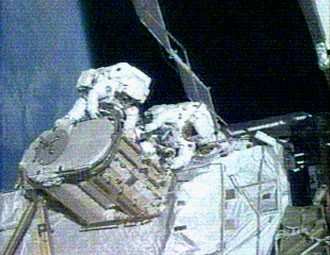
Two other spacewalks from Quest will follow. Lopez-Alegria and
Williams are scheduled to make the second spacewalk on February 4
and the third for February 8. The first two focus on the
reconfiguration of station power and cooling systems to permanent
ones.
Lopez-Alegria -- the lead spacewalker wearing the suit with red
stripes -- and Williams, in the all-white suit, began the tasks of
the first spacewalk by reconfiguring one of the two cooling loops
serving Destiny from the temporary to the permanent system.
Working at the "rats’ nest," an area near the base of the
Z1 Truss with numerous fluid and electrical connections,
Lopez-Alegria reconfigured the fluid loop connections, moving two
of the fluid lines from the early system from the lab and
connecting them back up to the Z1 panel. That will help enable
reactivation of the early cooling system if it should be
required.
He also connected a cable for the Space Shuttle Power Transfer
System (SSPTS). It will allow power from the station’s solar
arrays to be transferred to a docked space shuttle, beginning with
STS-118 in June. Williams also reconfigured several electrical
connections.
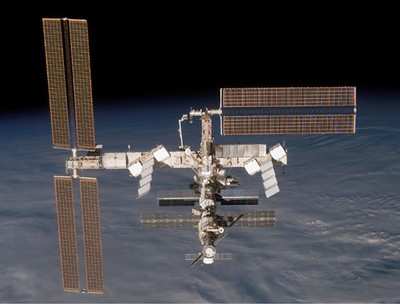
Next the spacewalkers stood by as the ground retracted the
starboard radiator of the P6 Truss. After retraction they installed
six cable cinches and two winch bars to secure the radiator and
then installed a shroud over it.
Lopez-Alegria and Williams then moved to the Early Ammonia
Servicer on the P6 Truss. It provided a contingency supply of
ammonia for the Early Ammonia System, which is no longer needed now
that a permanent cooling system is in place. The spacewalkers
removed one of two fluid lines from the servicer, which will be
jettisoned this summer. Because of time constraints, the second
will be removed on a subsequent spacewalk.
There were some tense moments, as Williams noted near the end of
the spacewalk there were four small, frozen "flakes" of ammonia
drifting from one of the caps on an old fluid line, and close to
where Lopez-Alegria was working. Those flakes could be toxic to an
astronaut if they came in contact with them... but fortunately,
Williams was "pretty positive" none of the flakes hit her
spacewalking partner.
To be sage, both astronauts spent about 25 minutes in a
"bakeout," after they re-entered the airlock, to make sure any
ammonia flakes had evaporated and cleared the area before the
spacewalkers took off their suits.
The three spacewalks from the Quest airlock in US spacesuits,
and a Russian spacewalk scheduled for February 22, will be the most
ever done by station crew members during a single month. They also
will bring to 10 the total number of spacewalks by Lopez-Alegria,
an astronaut record. Williams will have a total of four, the most
ever by a female astronaut.
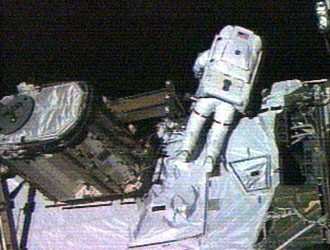
There's a reason NASA prefers to group its spacewalks so close
together. Starting from scratch, it takes about 100 crewmember
hours to prepare for a spacewalk. By doing spacewalks a few days
apart, considerable crew time can be saved by not having to repeat
some of those preparatory steps.



 ANN's Daily Aero-Linx (04.15.24)

 See All