Javelin Flies Higher, Faster After Improvements | Aero-News Network
Aero-News Network
RSS icon RSS feed
podcast icon MP3 podcast
Subscribe Aero-News e-mail Newsletter Subscribe

** AIRBORNE 05.21.13 Aero-TV-- CLICK HERE! ** HD iPad-Friendly Version -- AIRBORNE 05.21.13 **

** AIRBORNE 05.17.13 Aero-TV-- CLICK HERE! ** HD iPad-Friendly Version -- AIRBORNE 05.17.13 **

** AIRBORNE 04.01.13 SPECIAL EDITION of Aero-TV-- CLICK HERE! ** HD iPad-Friendly Version -- AIRBORNE 04.01.13 SPECIAL EDITION **

Wed, Jul 19, 2006

Javelin Flies Higher, Faster After Improvements

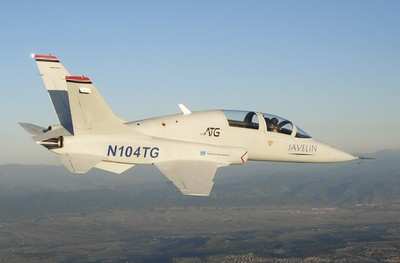
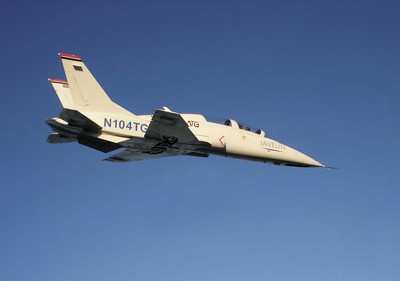
Last month, Aero-News reported on a series of minor improvements Aviation Technology Group made to its Javelin two-place jet... and on Wednesday, the company told ANN the changes appear to be yielding real benefits, as the Javelin prototype successfully completed two more flight tests in July, expanding its flight test envelope to higher speeds and altitudes.

ATG reports that during the most recent flights, the Javelin's new Fowler-type flaps were extended and retracted between full-up and 20 degrees. Test pilot Kirk Kalstad retracted the landing gear immediately after takeoff and pushed the Javelin to 335 knots true airspeed (385 mph) at 15,000 feet. Later, he climbed to 20,000 feet and accelerated to 0.5 Mach. Bank angles were tested up to 45 degrees.

Testing included an assessment of the handling qualities of the aircraft, which involved longitudinal, lateral and directional stability, as well as trim effectiveness. Tests also evaluated engine characteristics and performance, and verified airspeed and altitude indicators.

"Kirk reported that the aircraft handled well throughout all test points," said Rob Fuschino, VP of Operations and chase plane pilot. "An initial data review shows no anomalies from predicted results."

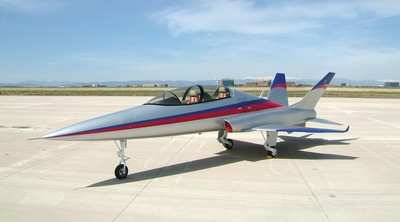
Prior to the most recent test flights, the Javelin prototype underwent a series of modifications to increase wing span by 1.85 feet, as well as improve the secondary flight control systems with the addition of the Fowler flaps. Updates were also made to the canopy of the sleek jet.

ATG also updated the test aircraft's airborne instrumentation data acquisition system (DAS), along with associated transducers.

Revisions made to the DAS included improvements to the cockpit audio and video capture, as well as the addition of extra-force measurements to flight control systems. Also, several high-sensitivity transducers were added to the Pitot-static system, which improves data for aerodynamicists.  

FMI: www.avtechgroup.com

Advertisement

More News

Four Companies Recognized With 2013 EBAA Safety Of Flight Awards

Cited For Focus On Maintaining And Improving Best Practices Four European companies have been recognized for their commitment to safe operations as recipients of the 2013 European >[...]

Classic Aero-TV: Viking Engines--Building A Rep For Alternative SportAv Engines

Rotax Is NOT The Only Player In Sport Aviation Propulsion Ya gotta hand to Viking... in an industry so VERY well dominated by Rotax, it takes some serious talent and extraordinary >[...]

ANN's Daily Aero-Linx (05.22.13)

The European Cockpit Association The European Cockpit Association (ECA) was created in 1991 and is the representative body of European pilots at European Union (EU) level. It repre>[...]

ANN's Daily Aero-Term (05.22.13): Known Traffic

With respect to ATC clearances, means aircraft whose altitude, position, and intentions are known to ATC.>[...]

Aero-News: Quote Of The Day (05.22.13)

"(T)he PC-24 is a completely new development – not a 'me too product'." Source: Oscar J. Schwenk, Chairman of the Board of Directors of Pilatus, introducing the company's new>[...]

blog comments powered by Disqus



Advertisement

Advertisement

Podcasts

Advertisement

© 2007 - 2013 Web Development & Design by Pauli Systems, LC