First Images Released From Lander
NASA's Mars Phoenix spacecraft sent its pictures late Sunday,
showing itself in good condition after making the first successful
landing in a polar region of Mars.
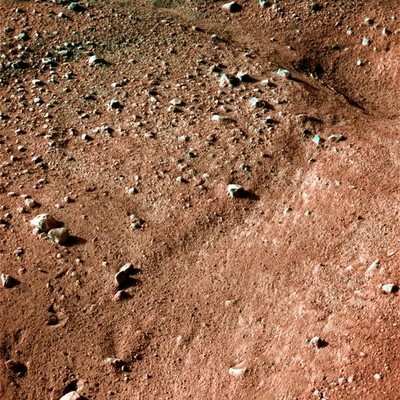
The images from NASA's Mars Phoenix Lander also provided a
glimpse of the flat valley floor expected to have water-rich
permafrost within reach of the lander's robotic arm. The landing
ends a 422-million-mile journey from Earth and begins a three-month
mission that will use instruments to taste and sniff the northern
polar site's soil and ice.
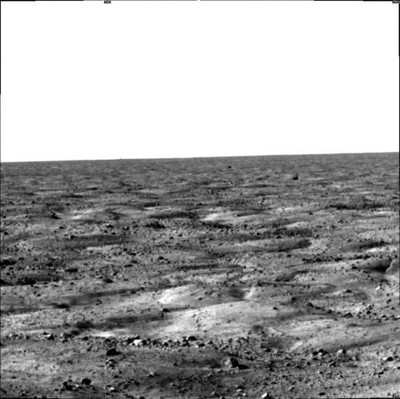
"We see the lack of rocks that we expected, we see the polygons
that we saw from space, we don't see ice on the surface, but we
think we will see it beneath the surface. It looks great to me,"
said Peter Smith of the University of Arizona, Tucson, principal
investigator for the Phoenix mission.
As ANN reported, signals
received at 4:53:44 pm Pacific Time confirmed that the Phoenix
Mars Lander had survived its difficult final descent and touchdown
15 minutes earlier. In the intervening time, those signals crossed
the distance from Mars to Earth at the speed of light. The
confirmation ignited cheers by mission team members at NASA's Jet
Propulsion Laboratory, Pasadena, CA; Lockheed Martin Space Systems,
Denver; and the University of Arizona.
As planned, Phoenix stopped transmitting one minute after
landing and focused its limited battery power on opening its solar
arrays, and other critical activities. About two hours after
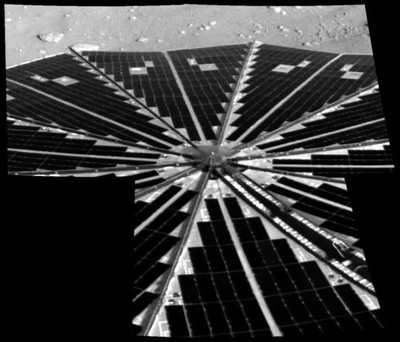
touchdown, it sent more good news. The first pictures confirmed
that the solar arrays needed for the mission's energy supply had
unfolded properly, and masts for the stereo camera and weather
station had swung into vertical position.
"Seeing these images after a successful landing reaffirmed the
thorough work over the past five years by a great team," said
Phoenix Project Manager Barry Goldstein of JPL. A key milestone
still ahead is the first use of the lander's 7.7-foot-long robotic
arm, not planned before Tuesday.
"Only five of our planet's 11 previous attempts to land on the
Red Planet have succeeded. In exploring the universe, we accept
some risk in exchange for the potential of great scientific
rewards,"said Ed Weiler, NASA associate administrator for the
Science Mission Directorate, Washington.
Phoenix carries science instruments to assess whether ice just
below the surface ever thaws and whether some chemical ingredients
of life are preserved in the icy soil. These are key questions in
evaluating whether the environment has ever been favorable for
microbial life. Phoenix will also study other aspects of the soil
and atmosphere with instrument capabilities never before used on
Mars. Canada supplied the lander's weather station.
Phoenix uses hardware from a spacecraft built for a 2001 launch
that was canceled in response to the loss of a similar Mars
spacecraft during a 1999 landing attempt. Researchers who proposed
the Phoenix mission in 2002 saw the unused spacecraft as a resource
for pursuing a new science opportunity. A few months earlier,
NASA's Mars Odyssey orbiter discovered that plentiful water ice
lies just beneath the surface throughout much of high-latitude
Mars. NASA chose the Phoenix proposal over 24 other proposals to
become the first endeavor in the Mars Scout program of
competitively selected missions.



 Airborne 04.16.24: RV Update, Affordable Flying Expo, Diamond Lil


 See All