United Launch Alliance Deems First RS-68A Hot-Fire Engine Test A Success | Aero-News Network
Aero-News Network
RSS icon RSS feed
podcast icon MP3 podcast
Subscribe Aero-News e-mail Newsletter Subscribe

** AIRBORNE 06.18.13 Aero-TV-- CLICK HERE! ** HD iPad-Friendly Version -- AIRBORNE 06.18.13 **

** AIRBORNE 06.14.13 Aero-TV-- CLICK HERE! ** HD iPad-Friendly Version -- AIRBORNE 06.14.13**

** AIRBORNE 04.01.13 SPECIAL EDITION of Aero-TV-- CLICK HERE! ** HD iPad-Friendly Version -- AIRBORNE 04.01.13 SPECIAL EDITION **

Sat, Sep 27, 2008

United Launch Alliance Deems First RS-68A Hot-Fire Engine Test A Success

Upgraded Rocket Motors To Power Delta IV Heavy Lift Booster

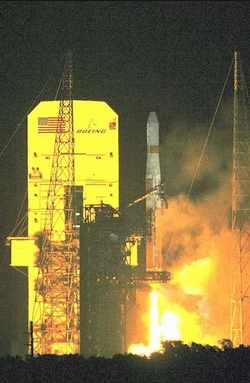
United Launch Alliance announced Thursday the successful first hot-firing of the new Pratt & Whitney Rocketdyne RS-68A engine that will be used to power a future upgraded version of the Delta IV Heavy Lift launch vehicle. The hot-fire test was conducted 3:16 pm CDT, at NASA's John C. Stennis Space Center in Mississippi. Stennis is the home of America's largest rocket engine test facility.

The RS-68A engine, an upgraded version of the current RS-68 liquid hydrogen-liquid oxygen engine used on Delta IV, will allow the Delta IV Heavy vehicle to boost heavier payloads into orbit. Currently, the RS-68 engine can deliver more than 660,000 pounds of sea level thrust and the upgraded RS-68A will increase this to more than 700,000 pounds. The RS-68A also improves on the specific impulse, or fuel efficiency, of the RS-68.

The Delta IV Heavy is comprised of three Delta IV core boosters. With the new RS-68A engines, the Delta IV Heavy's thrust will increase by more than 100,000 pounds.

The hot-fire test lasted the full planned duration of approximately 40 seconds and the test team will spend the next several days evaluating data to characterize engine performance and to clear the engine for future tests. This initial test was on the first of three engines that will be used during an extensive engine test program. The test program will continue during the next twelve months, leading to certification of the new engine in mid-2010 and initial launch capability of the upgraded Delta IV Heavy in early 2011.

"We congratulate Pratt & Whitney Rocketdyne and the entire RS-68A engine team for this successful first step in making the most powerful liquid hydrogen-liquid oxygen engine in the world even more capable," said Jim Sponnick, ULA Vice President, Delta Product Line. "The RS-68A upgrade is a critical element in upgrading the Delta IV Heavy allowing ULA to meet evolving needs of our government customers with even greater reliability and performance than achieved in the past, while keeping mission success our top priority."

ULA program management, engineering, test and mission support functions are headquartered in Denver, CO. Manufacturing, assembly and integration operations are located in Decatur, AL, Harlingen, TX, San Diego, CA, and Denver, CO. Launch operations are located at Cape Canaveral Air Force Station, FL, and Vandenberg Air Force Base, CA.

FMI: www.ulalaunch.com

Advertisement

More News

Aero-TV: Garmin’s GNC-255 –- Back To Basics

Garmin's New Aviation VHF Radios Early this year, a new series of aviation VHF COM and NAV/COM radios, the GTR and GNC series, was announced by Garmin. As the replacement products >[...]

EADS And Siemens Enter Long-Term Research Partnership

Sign MoU With Diamond Aircraft On Electric Propulsion System EADS and Siemens are entering into a long-term research partnership to introduce new electric propulsion systems that c>[...]

ANN's Daily Aero-Term (06.19.13): Ceiling

The heights above the earth's surface of the lowest layer of clouds or obscuring phenomena that is reported as broken, overcast, or obscuration, and not classified as thin or parti>[...]

ANN's Daily Aero-Linx (06.19.13)

The Army Aviation Heritage Foundation The Army Aviation Heritage Foundation (AAHF) is a non-profit public educational foundation dedicated to presenting the Army Aviation story to >[...]

Aero-News: Quote Of The Day (06.19.13)

“The serial electric propulsion allows us to design airplanes with totally different characteristics than today. Vertical take-off and high-speed cruise can be realized in a >[...]

blog comments powered by Disqus


Advertisement

Advertisement

Podcasts

Advertisement

© 2007 - 2013 Web Development & Design by Pauli Systems, LC