
Boeing's Little Bird Demonstrator Helo Flies Unmanned For First Time | Aero-News Network
Aero-News Network
RSS icon RSS feed
podcast icon MP3 podcast
Subscribe Aero-News e-mail Newsletter Subscribe

** AIRBORNE 05.24.13 Aero-TV-- CLICK HERE! ** HD iPad-Friendly Version -- AIRBORNE 05.24.13 **

** AIRBORNE 05.21.13 Aero-TV-- CLICK HERE! ** HD iPad-Friendly Version -- AIRBORNE 05.21.13 **

** AIRBORNE 04.01.13 SPECIAL EDITION of Aero-TV-- CLICK HERE! ** HD iPad-Friendly Version -- AIRBORNE 04.01.13 SPECIAL EDITION **

Thu, Jul 13, 2006

Boeing's Little Bird Demonstrator Helo Flies Unmanned For First Time

Control System Could Be Retrofitted To Several Other Copters

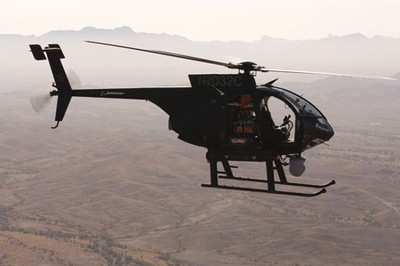
Aero-News learned Thursday that on June 30, Boeing's Unmanned Little Bird (ULB) technology demonstrator helicopter flew unmanned for the first time.

The test occurred at the US Army's Yuma Proving Ground in Yuma, AZ, about 130 miles from the Boeing Rotorcraft facility in Mesa, AZ where Boeing has tested the aircraft -- a modified MD530F single-turbine helicopter -- over the past two years with a safety pilot on board.

Boeing reports that for the truly unmanned test, the aircraft lifted off from a helipad, hovered briefly and flew a programmed armed intelligence, surveillance and reconnaissance mission around the proving ground. After the 20-minute flight, the aircraft returned to the helipad and landed within six inches of the planned recovery location.

Prior to the fully unmanned demonstration, the ULB Demonstrator had flown more than 450 hours of engineering flight test time as a rapid prototyping platform, developing and integrating the sensors and systems necessary to create an operational unmanned aerial vehicle (UAV).

"Expansion of the flight envelope to include true unmanned flight is a major milestone for the program and opens doors to a wide range of applications for this aircraft," said Dino Cerchie, Advanced Systems program manager for the ULB Demonstrator and A/MH-6X Little Bird programs, a part of Advanced Rotorcraft Systems for Boeing. "Previous autonomous demonstrations with this aircraft have included target identification, precision re-supply, communication relay and weapons firings."

The ULB Demonstrator mission payload for the first unmanned flight weighed more than 740 pounds, not including fuel weight. The aircraft lifted off at 3,000 pounds, but could have added an additional 550 pounds of payload.

The A/MH-6X configuration, which is expected to make its first flight later this summer, adds an additional 800 pounds of payload to the ULB Demonstrator design, giving it even greater flexibility in the field.

"The Unmanned Little Bird offers potential operators a low-cost, multi-purpose aircraft that will provide manned or unmanned options in combat, making it a versatile and easily deployable asset on future battlefields," said Cerchie. "We are clearly demonstrating the unmatched advantages of combining a cost-effective, proven airframe with emerging manned-unmanned network centric technologies."

The prototype aircraft is validating an autonomous flight control system that could be added to any manned aircraft. This automated flight control system includes integrated weapons systems, sensors and a ground control station.

Cerchie said the entire package could be retrofitted to most existing rotorcraft. One candidate for remotely operating a ULB aircraft is the AH-64D Apache Longbow multi-role combat helicopter, which already has demonstrated such capabilities during UAV test programs.

FMI: www.boeing.com

Advertisement

More News

Update: Startling... FAA Wants EAA To Pay Them To Staff Oshkosh

Could The FAA Get ANY Stranger? Worse Yet... Will They? ANN RealTime News Update, 1324ET, 05.23.13: Well... the statement we were promised YESTERDAY showed up today... and it doesn>[...]

Aspen Avionics Evolution Backup Display Expands To Piper Archer, Seminole

Aspen’s All Digital Backup Display Will Give Flight-Training Students The Total Glass Panel Experience Aspen Avionics announced Tuesday that Piper Aircraft has selected the E>[...]

Classic Aero-TV: EAA’s Jack Pelton – ‘Everything’s Going to Be OK’

Building A New Future For The EAA... One Issue At A Time Originally WebCast 11.14.12: With only a couple of weeks in pocket, directing the reorganization of the EAA in the wake of >[...]

House Committee Hearing Focuses On Strategic Stepping Stones To Mars

Subcommittee Chair Call Mars Mission A Congressional Priority The House Science Committee Subcommittee on Space held a hearing Tuesday to examine possible options for the next step>[...]

Dassault Falcon Embarks On Spares Pricing Overhaul

Third Such Restructuring In 10 Years Dassault Falcon has embarked on its third parts pricing overhaul in the past 10 years, assessing the cost of over 18,500 individual items. The >[...]

blog comments powered by Disqus



Advertisement

Advertisement

Podcasts

Advertisement

© 2007 - 2013 Web Development & Design by Pauli Systems, LC