Boeing 747-8 Makes Million-Pound Departure | Aero-News Network
Aero-News Network
RSS icon RSS feed
podcast icon MP3 podcast
Subscribe Aero-News e-mail Newsletter Subscribe

** AIRBORNE 06.18.13 Aero-TV-- CLICK HERE! ** HD iPad-Friendly Version -- AIRBORNE 06.18.13 **

** AIRBORNE 06.14.13 Aero-TV-- CLICK HERE! ** HD iPad-Friendly Version -- AIRBORNE 06.14.13**

** AIRBORNE 04.01.13 SPECIAL EDITION of Aero-TV-- CLICK HERE! ** HD iPad-Friendly Version -- AIRBORNE 04.01.13 SPECIAL EDITION **

Wed, Aug 25, 2010

Boeing 747-8 Makes Million-Pound Departure

RC521 Flies More Than 25,000 Pounds Over MTOW

Under normal circumstances, its inadvisable to attempt a departure well over maximum takeoff weight, but certification is not "normal circumstances." And so, Boeing engineers last week loaded up the second 747-8 test aircraft to more than 25,000 pounds over its 975,000 designed maximum weight, and pointed it down the runway.


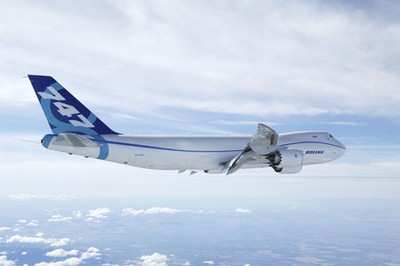
File Photo

It wasn't that easy, of course. Boeing said in a prepared report that weeks of planning went into the test. "In flight test, we test the airplane's capabilities above and beyond the normal operating conditions," says Andy Hammer, flight test manager for the 747-8. "This way, we can clearly demonstrate to the customers, the regulatory agencies, and the passengers that the aircraft is capable of performing at these levels."

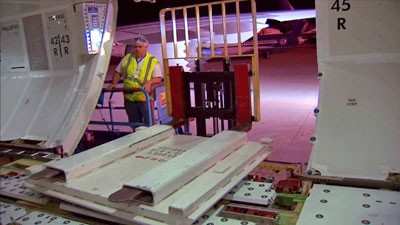
For the test, RC521 was first filled with literally tons of fuel. Then, dozens of steel plates weighing 3,000 each were loaded into the lower cargo hold. The result was an airplane that weighed 1,005,000 pounds when it started down the 15,000 foot runway. "It's a lot of mass, a lot of energy. I have to stay ahead of it," said Captain Paul Stemer as the runway in front of him rapidly vanished.


Engineers Load Steel Plates Boeing Photo

Then, with about 4,500 feet of pavement left, the airplane lifted into the air. "A lot of planning went into this," Hammer said. "We had to demonstrate that the wheels, tires and brakes are in position to support it. We had to demonstrate the performance of the aircraft, from an aero perspective, is okay."

After getting airborne, Stemer flew the heavy 747-8 for 4 hours before landing back at the California airport. The flight is now in the books as the being the heaviest takeoff in Boeing history.

FMI: www.boeing.com

Advertisement

More News

Aero-TV: Garmin’s GNC-255 –- Back To Basics

Garmin's New Aviation VHF Radios Early this year, a new series of aviation VHF COM and NAV/COM radios, the GTR and GNC series, was announced by Garmin. As the replacement products >[...]

EADS And Siemens Enter Long-Term Research Partnership

Sign MoU With Diamond Aircraft On Electric Propulsion System EADS and Siemens are entering into a long-term research partnership to introduce new electric propulsion systems that c>[...]

ANN's Daily Aero-Term (06.19.13): Ceiling

The heights above the earth's surface of the lowest layer of clouds or obscuring phenomena that is reported as broken, overcast, or obscuration, and not classified as thin or parti>[...]

ANN's Daily Aero-Linx (06.19.13)

The Army Aviation Heritage Foundation The Army Aviation Heritage Foundation (AAHF) is a non-profit public educational foundation dedicated to presenting the Army Aviation story to >[...]

Aero-News: Quote Of The Day (06.19.13)

“The serial electric propulsion allows us to design airplanes with totally different characteristics than today. Vertical take-off and high-speed cruise can be realized in a >[...]

blog comments powered by Disqus



Advertisement

Advertisement

Podcasts

Advertisement

© 2007 - 2013 Web Development & Design by Pauli Systems, LC