New Method Gives Up To One Hour Warning
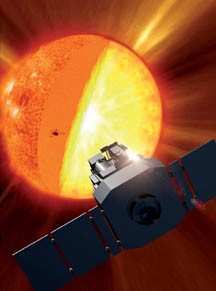 NASA's Solar and
Heliospheric Observatory (SOHO) now enables scientists to forecast
solar radiation storms, giving future astronauts, traveling to the
moon and Mars, time to seek shelter and ground controllers time to
safeguard satellites.
NASA's Solar and
Heliospheric Observatory (SOHO) now enables scientists to forecast
solar radiation storms, giving future astronauts, traveling to the
moon and Mars, time to seek shelter and ground controllers time to
safeguard satellites.
The new method offers as much as one hour advance notice when a
storm is approaching, according to NASA.
"Solar radiation storms are notoriously difficult to predict.
They often take us by surprise, but now we've found a way to
anticipate these events," says Arik Posner, a physicist in NASA's
Science Mission Directorate, Washington and developer of the
technique.
Solar radiation storms are swarms of electrons, protons and
heavy ions accelerated to high speed by explosions on the sun. On
Earth, humans are protected from these particles by Earth's
atmosphere and magnetic field. Astronauts in Earth orbit are also
protected since Earth's magnetic field extends far enough to shield
them.
Solar radiation storms are a potential risk factor for
astronauts working on the surface of the moon or Mars since neither
has a substantial magnetic, protective field.
"A one hour warning would reduce the odds of being caught in a
solar storm outside of a lunar habitat, where astronauts are most
vulnerable," says Francis Cucinotta, chief scientist for the NASA
Space Radiation Program at NASA's Johnson Space Center,
Houston.
Spacecraft and satellites would also benefit. Subatomic
particles striking computer processors and other electronics can
cause onboard computers to malfunction. If a satellite operator
knows a storm is on its way, the craft can be placed in a
protective "safe mode" until the storm passes.
The type of particle most feared by safety experts is the ion,
an atom that has lost one or more of its charge-balancing
electrons. Energetic ions have the ability to damage tissue and
break strands of DNA, an effect not fully understood in terms of
human disease.
The goal of researchers is to forecast when the ions will
arrive.
"The key is electrons. They are always detected ahead of the
more dangerous ions," says Posner. While this has been known for
years, only recently has this research turned the "electrons first"
aspect of radiation storms into a tool for forecasting.
 Every radiation storm is a mix of
electrons, protons and heavier ions. The electrons, being lighter
and faster than the others, race out ahead. By measuring the "rise
time and intensity of the initial electron surge" Posner could
predict how many ions were following and when they would
arrive.
Every radiation storm is a mix of
electrons, protons and heavier ions. The electrons, being lighter
and faster than the others, race out ahead. By measuring the "rise
time and intensity of the initial electron surge" Posner could
predict how many ions were following and when they would
arrive.
The key to the breakthrough was the Comprehensive Suprathermal
and Energetic Particle Analyzer (COSTEP) instrument on board the
observatory. COSTEP counts particles coming from the sun and
measures their energies. Posner looked at hundreds of radiation
storms recorded by COSTEP between 1996 and 2002, and was able to
construct an empirical, predictive matrix that involved plugging
electron data into the matrix, and an ion forecast emerging.
After testing the results, the matrix was used on COSTEP data
gathered in 2003 and it successfully predicted all four major ion
storms that year with advance warnings ranging from 7 to 74
minutes.
"While the method is not yet perfect, I'd like to improve that,"
Posner says.
The method is being considered by planners at the Johnson Space
Center in their design of future lunar missions.
"Posner's technique reduces the odds of exposure by more than 20
percent compared to current methods, allowing astronauts to venture
farther from their outpost. That's good for both science and
exploration," says Cucinotta.



 ANN's Daily Aero-Linx (04.16.24)


 See All