Tue, May 25, 2010
Pentagon Denies That The Spacecraft Is A Spy Satellite Test
Bed
The mission of the X-37B Space Plane that launched from Cape
Canaveral last month was shrouded in secrecy. And while the
Pentagon insists that the project seeks "no offensive capabilities"
as far as space-based weapons are concerned, Pentagon leaders have
said that the spacecraft's ultimate mission would be to assist
terrestrial war fighters with any number of missions. Some with
inside knowledge of the program have suggested that the vehicle
could be testing sensors for a new generation of spy satellites,
which the Pentagon has also denied.
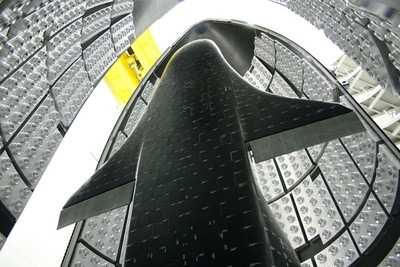
Civilian specialists, meanwhile, have said it could fly for up
to 9 months before returning to California for a landing. The
New York Times reports that a group of amateur sky watchers has
tracked X-37B as it orbits the earth. One person in Toronto said
the spacecraft was passing over the same area once every four days.
Ted Molczan said that is a fairly normal pattern for U.S.
reconnaissance satellites.
On a clear night, the X-37B could be visible to the naked eye in
some areas, appearing like a bright star moving across the sky. The
amateur astronomers say they have tracked the ship from as far as
40 degrees north latitude to 40 degrees south latitude. That orbit
would take it over some of the world's most troubled regions, such
as Iraq, Iran, Pakistan, Afghanistan, and North Korea. It appears
to be in an orbit at about 255 miles in altitude, circling the
earth every 90 minutes, much like the shuttle.
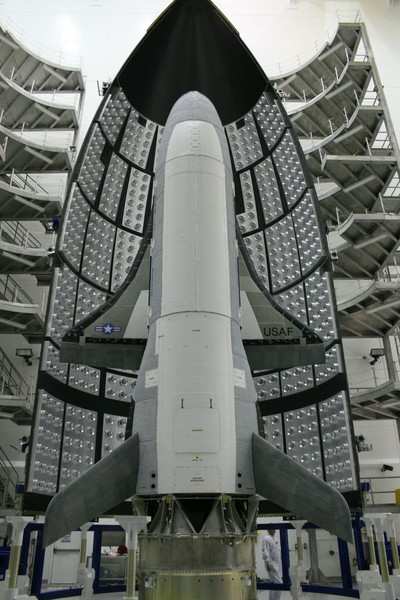
The spacecraft, which resembles the shuttle but is about a
quarter of its size with a 14 foot wingspan, was boosted into orbit
on an Atlas 5 rocket with no real explanation of its mission. A
Harvard astronomer who tracks launches and space activity said the
secrecy included sending the rocket's upper stage into an
undisclosed orbit around the sun, the first time the U.S.
Government has done so.
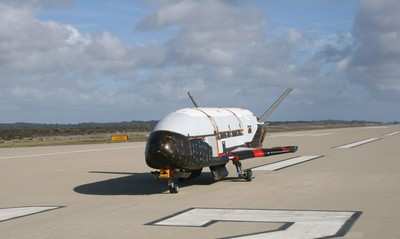
Brian Weedon of the Secure World Foundation said the X-37B could
prove to be a critical asset for rapid reconnaissance missions,
based on the ability of crews to quickly change its payload and
launch it into space. But the former Air Force officer questioned
the need for all the secrecy. He told the paper that if the
spacecraft could be located by a "bunch of amateurs," then it's
likely our enemies could find it as well.
More News
Light Gun A handheld directional light signaling device which emits a brilliant narrow beam of white, green, or red light as selected by the tower controller. The color and type of>[...]
"The journey to this achievement started nearly a decade ago when a freshly commissioned Gentry, driven by a fascination with new technologies and a desire to contribute significan>[...]
Aero Linx: JAARS, Inc. For decades now, we’ve landed planes on narrow rivers and towering mountains. We’ve outfitted boats and vehicles to reach villages that rarely se>[...]
"Our driven and innovative team of military and civilian Airmen delivers combat power daily, ensuring our nation is ready today and tomorrow." Source: General Duke Richardson, AFMC>[...]
Aircraft Conflict Predicted conflict, within EDST of two aircraft, or between aircraft and airspace. A Red alert is used for conflicts when the predicted minimum separation is 5 na>[...]



 ANN's Daily Aero-Term (04.20.24): Light Gun


 See All