NASA Launches Next-Generation Communications Satellite | Aero-News Network
Aero-News Network
RSS icon RSS feed
podcast icon MP3 podcast
Subscribe Aero-News e-mail Newsletter Subscribe

** AIRBORNE 05.21.13 Aero-TV-- CLICK HERE! ** HD iPad-Friendly Version -- AIRBORNE 05.21.13 **

** AIRBORNE 05.17.13 Aero-TV-- CLICK HERE! ** HD iPad-Friendly Version -- AIRBORNE 05.17.13 **

** AIRBORNE 04.01.13 SPECIAL EDITION of Aero-TV-- CLICK HERE! ** HD iPad-Friendly Version -- AIRBORNE 04.01.13 SPECIAL EDITION **

Fri, Feb 01, 2013

NASA Launches Next-Generation Communications Satellite

Two Additional TDRS Spacecraft To Be Placed In Orbit Over The Next Two Years

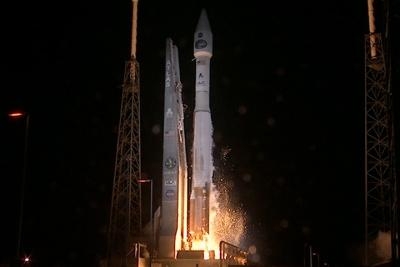
The first of NASA's three next-generation Tracking and Data Relay Satellites (TDRS), known as TDRS-K, launched at 8:48 p.m. EST Wednesday from Cape Canaveral Air Force Station in Florida. "TDRS-K bolsters our network of satellites that provides essential communications to support space exploration," said Badri Younes, deputy associate administrator for Space Communications and Navigation at NASA Headquarters in Washington. "It will improve the overall health and longevity of our system."

The TDRS system provides tracking, telemetry, command and high-bandwidth data return services for numerous science and human exploration missions orbiting Earth. These include the International Space Station and NASA's Hubble Space Telescope. "With this launch, NASA has begun the replenishment of our aging space network," said Jeffrey Gramling, TDRS project manager. "This addition to our current fleet of seven will provide even greater capabilities to a network that has become key to enabling many of NASA's scientific discoveries."

TDRS-K was lifted into orbit aboard a United Launch Alliance Atlas V rocket from Space Launch Complex-41. After a three-month test phase, NASA will accept the spacecraft for additional evaluation before putting the satellite into service.

The TDRS-K spacecraft includes several modifications from older satellites in the TDRS system, including redesigned telecommunications payload electronics and a high-performance solar panel designed for more spacecraft power to meet growing S-band requirements. Another significant design change, the return to ground-based processing of data, will allow the system to service more customers with evolving communication requirements. The next TDRS spacecraft, TDRS-L, is scheduled for launch in 2014. TDRS-M's manufacturing process will be completed in 2015.

(Image provided by NASA)

FMI: www.nasa.gov/tdrs

Advertisement

More News

X-47B Accomplishes Its First Ever Carrier Touch And Go

Maneuver Performed Aboard CVN 77 The Navy's X-47B Unmanned Combat Air System Demonstrator (UCAS-D) began touch and go landing operations aboard the aircraft carrier USS George H.W.>[...]

Honeywell's New HTF7350 Engine To Power Bombardier Challenger 350

HTF7000 Series Surpasses 1.5 Million Flight Hours With Better Than 99 Percent Dispatch Reliability Honeywell has announced that its HTF7350, the latest engine to join its successfu>[...]

Airborne 05.21.13: Cirrus Chute Fails, NASA Record, More NIMBY Nonsense

Also: PC-12 Record, Maule Nation, Cockpit Lockout, 34,000 Airliners Needed, Beechcraft Wins Big Contract You know you're having a bad day when a flight goes so bad that you feel yo>[...]

Helo Crew Missing From Vietnam War Accounted For, Interred At Arlington

Four Buried As A Group May 2 A Navy Pilot, missing from the Vietnam War, has been accounted-for and was buried with full military honors along with his crew. According to the Depar>[...]

ANN's Daily Aero-Linx (05.21.13)

Forest Service Smoke Jumpers Smokejumping was first proposed in 1934 by T.V. Pearson, the Forest Service Intermountain Regional Forester, as a means to quickly provide initial atta>[...]

blog comments powered by Disqus



Advertisement

Advertisement

Podcasts

Advertisement

© 2007 - 2013 Web Development & Design by Pauli Systems, LC