Air Force Pilot Missing From Vietnam War Identified | Aero-News Network
Aero-News Network
RSS icon RSS feed
podcast icon MP3 podcast
Subscribe Aero-News e-mail Newsletter Subscribe

** AIRBORNE 05.24.13 Aero-TV-- CLICK HERE! ** HD iPad-Friendly Version -- AIRBORNE 05.24.13 **

** AIRBORNE 05.21.13 Aero-TV-- CLICK HERE! ** HD iPad-Friendly Version -- AIRBORNE 05.21.13 **

** AIRBORNE 04.01.13 SPECIAL EDITION of Aero-TV-- CLICK HERE! ** HD iPad-Friendly Version -- AIRBORNE 04.01.13 SPECIAL EDITION **

Fri, Oct 19, 2007

Air Force Pilot Missing From Vietnam War Identified

Major Robert Lapham Is Home At Last

The Department of Defense POW/Missing Personnel Office (DPMO) announced Thursday the remains of a US serviceman, missing from the Vietnam War, have been identified and returned to his family for burial with full military honors. He is Maj. Robert G. Lapham, US Air Force, of Marshall, MI. He will be buried Friday in Arlington National Cemetery near Washington, DC.

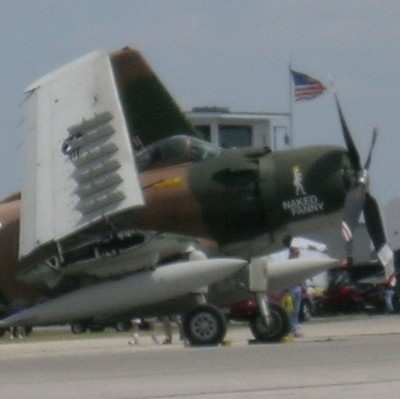
On February 8, 1968, Lapham was flying the lead A-1G Skyraider in a flight of two in Quang Tri Province, Vietnam. The aircraft were alerted to join an airborne forward air controller to destroy enemy tanks that had overrun the Lang Vei Special Forces Camp.

After completing one pass on the tanks, Lapham was nearing his target on the second pass when he crashed. The crew of the other aircraft involved in the mission reported seeing no parachute.

Between 1993 and 1998, joint US/Socialist Republic of Vietnam (SRV) teams, led by the Joint POW/MIA Accounting Command (JPAC), traveled to Quang Tri Province two times to investigate the incident and interview witnesses. One team also surveyed the crash site and found aircraft wreckage.

In 2003, another joint team investigated the incident and resurveyed the crash site. The team found more wreckage and pilot-related evidence, including Lapham's identification tag. Between 2004 and 2006, JPAC teams traveled to Quang Tri Province four times to excavate the crash site. The teams recovered human remains, aircraft wreckage and pilot-related items. 

Among other forensic identification tools and circumstantial evidence, scientists from JPAC also used dental comparisons in the identification of the remains. 

FMI: www.dtic.mil/dpmo

Advertisement

More News

ANN's Daily Aero-Linx (05.25.13)

Three-Eight Charlie If you know the name of the first woman to fly solo around the world, you’re ahead of most people. By the way, if you thought it was Amelia Earhart, you&r>[...]

ANN's Daily Aero-Term (05.25.13): Holding Pattern

Holding pattern. A racetrack pattern, involving two turns and two legs, used to keep an aircraft within a prescribed airspace with respect to a geographic fix.>[...]

Aero-News: Quote Of The Day (05.25.13)

“We need a world-class system of weather prediction in the United States – one, as the National Academy of Sciences recently put it, that is ‘second to none'." So>[...]

ANN FAQ: Share Aero-News With Your Friends

Send Them A Story -- We Don't Mind! Do you need another set of eyes to see that story you can't believe Jim just wrote? Want to spread Hognose's unique wisdom and perspective to th>[...]

Flight Attendant Union Endorses Ed Markey For U.S. Senate

Cites 'Strong Record On Aviation Security' The Association of Flight Attendants-CWA (AFA) has endorsed Congressman Ed Markey for the U.S. Senate, specifically noting his proven rec>[...]

blog comments powered by Disqus



Advertisement

Advertisement

Podcasts

Advertisement

© 2007 - 2013 Web Development & Design by Pauli Systems, LC