SpaceX's Grasshopper Takes Giant Leap Towards Reusability With 12-Story Flight | Aero-News Network
Aero-News Network
RSS icon RSS feed
podcast icon MP3 podcast
Subscribe Aero-News e-mail Newsletter Subscribe

** AIRBORNE 05.21.13 Aero-TV-- CLICK HERE! ** HD iPad-Friendly Version -- AIRBORNE 05.21.13 **

** AIRBORNE 05.17.13 Aero-TV-- CLICK HERE! ** HD iPad-Friendly Version -- AIRBORNE 05.17.13 **

** AIRBORNE 04.01.13 SPECIAL EDITION of Aero-TV-- CLICK HERE! ** HD iPad-Friendly Version -- AIRBORNE 04.01.13 SPECIAL EDITION **

Thu, Dec 27, 2012

SpaceX's Grasshopper Takes Giant Leap Towards Reusability With 12-Story Flight

Twenty-Nine Second 'Hop' Tested Closed Loop Thrust Vector And Throttle Control

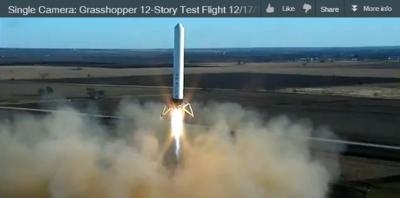
SpaceX's Grasshopper took a 12-story leap towards full and rapid rocket reusability in a test flight conducted December 17, 2012 at SpaceX’s rocket development facility in McGregor, Texas.

Grasshopper, SpaceX’s vertical takeoff and landing vehicle (VTVL), rose 131 feet, hovered and landed safely on the pad using closed loop thrust vector and throttle control. The total test duration was 29 seconds.

Grasshopper stands 10 stories tall and consists of a Falcon 9 rocket first stage, Merlin 1D engine, four steel landing legs with hydraulic dampers, and a steel support structure.

The 12-story flight marks a significant increase over the height and length of hover of Grasshopper’s previous test flights, which took place earlier this fall. In September, Grasshopper flew to 6 feet, and in November, it flew to 17.7 feet/2 stories including a brief hover.

Testing of Grasshopper will continue with successively more sophisticated flights expected over the next several months.

SpaceX is conducting the tests in three phases, with the first being these low-altitude short-duration flights. According to a draft FAA Environmental Impact Assessment published in 2011, in Phase 2, there would be slightly less propellant loaded, a different thrust profile, and the maximum altitude would be increased to 670 feet, still below Class E Airspace. The mission duration during Phase 2 is again approximately 45 seconds.

The goal of Phase 3 is to verify the Grasshopper RLV’s ability to perform a VTVL mission at higher altitudes and higher ascent speeds and descent speeds. To achieve this, the maximum mission altitude would be increased from 670 feet incrementally up to 11,500 feet. The altitude test sequence likely would be 1,200 feet; 2,500 feet; 5,000 feet; 7,500 feet; and 11,500 feet. The maximum test duration would be approximately 160 seconds. The Grasshopper RLV would land back on the launch pad.

(Image from SpaceX YouTube Video)

FMI: www.spacex.com

Advertisement

More News

Update: Startling... FAA Wants EAA To Pay Them To Staff Oshkosh

Could The FAA Get ANY Stranger? Worse Yet... Will They? ANN RealTime News Update, 1324ET, 05.23.13: Well... the statement we were promised YESTERDAY showed up today... and it doesn>[...]

Aspen Avionics Evolution Backup Display Expands To Piper Archer, Seminole

Aspen’s All Digital Backup Display Will Give Flight-Training Students The Total Glass Panel Experience Aspen Avionics announced Tuesday that Piper Aircraft has selected the E>[...]

Classic Aero-TV: EAA’s Jack Pelton – ‘Everything’s Going to Be OK’

Building A New Future For The EAA... One Issue At A Time Originally WebCast 11.14.12: With only a couple of weeks in pocket, directing the reorganization of the EAA in the wake of >[...]

House Committee Hearing Focuses On Strategic Stepping Stones To Mars

Subcommittee Chair Call Mars Mission A Congressional Priority The House Science Committee Subcommittee on Space held a hearing Tuesday to examine possible options for the next step>[...]

Dassault Falcon Embarks On Spares Pricing Overhaul

Third Such Restructuring In 10 Years Dassault Falcon has embarked on its third parts pricing overhaul in the past 10 years, assessing the cost of over 18,500 individual items. The >[...]

blog comments powered by Disqus


Advertisement

Advertisement

Podcasts

Advertisement

© 2007 - 2013 Web Development & Design by Pauli Systems, LC